Saturday, December 08, 2007

Wildcatters keep lead


Photos by Mark M. Hancock / © The Beaumont Enterprise

Wildcatters' Jonathan Paiement (No. 94, right) and Gwinnett's Derek Nesbitt (No. 17, left) battle for the puck during an ECHL hockey game at Ford Arena in Beaumont on Saturday, Dec. 1, 2007.


Wildcatters' Marc Fulton (No. 23, left) and Gwinnett's Jon Sitko (No. 24, right) slam into the glass behind Gwinnett's goal during an ECHL hockey game.


Wildcatters' Anton Khudobin (No. 35. left) blocks a shot while Jordie Preston (No. 17, right) moves in to assist during an ECHL hockey game against Gwinnett.


Wildcatters' Michael Grenzy (No. 3, top) flips the puck over the leg of Gwinnett's Dan Turple (No. 38, bottom) for a goal during an ECHL hockey game at Ford Arena in Beaumont. The Wildcatters won the game 3-2 and keep the ECHL South lead.

Friday, December 07, 2007

Mustangs get corralled


Fourteen-month-old Brennan Jones, grandson of West Orange-Stark's head coach Dan Hooks, strides down the sideline before a Class 3A high school football playoff game at Sam Houston State University in Huntsville on Friday, Nov. 30, 2007.


Photos by Mark M. Hancock / © The Beaumont Enterprise


Brandon Allensworth (No. 66, center) and the rest of the West Orange-Stark team takes the field before the Class 3A Division II high school football playoff game against Waco LaVega at Sam Houston State University.


West Orange-Stark's Ronnie Dennis pulls in a reception to set up the team's first touchdown against Waco LaVega during a high school football playoff game.


West Orange-Stark's Jacorey Roberts (No. 54, left) and Carltives Zetar (No. 32, center) sack Waco LaVega's Danzel Wilson (No. 4, right) during the playoff game in Huntsville.


WO-S's DePauldrick Garrett (No. 24, left) gets hit by LaVega's Reco Pardue (No. 30, right) during the football playoff game. LaVega won 20-12 and ended WO-S's season.

Thursday, December 06, 2007

Cards slam the Cavs


Lamar's Justin Nabors (No. 24, left) slams the ball through the hoop against St. Gregory's in the Montagne Center at Lamar University in Beaumont on Tuesday, Dec. 4, 2007.

Photos by Mark M. Hancock / © The Beaumont Enterprise


St. Gregory's Sam Stuart (No. 34, right) tries to block the shot of Lamar's Ashton Hall (No. 15, left) during a college basketball game in the Montagne Center at Lamar University.


Lamar's Ashton Hall (No. 15, left) and Matthew Barrow (No. 23, right) trap St. Gregory's Kyle Lulko (No. 3, center) during a college basketball game in the Montagne Center at Lamar University. Lamar beat the Cavs 95-59 and broke a five-game losing streak.

Wednesday, December 05, 2007

More West End jewelers


Marty Banda (top) and Pilar Serna (bottom) with National Signs install a sign at James Avery jewelry store in the Fountain Plaza in Beaumont on Thursday, Nov. 29, 2007. Not including Parkdale Mall, three other jewelry stores already exist in the area near the newest store.

Mark M. Hancock / © The Beaumont Enterprise


Please read "James Avery jewelry store opens..." by Heather Nolan.

Tuesday, December 04, 2007

Upscale downtown urbanity


Photos by Mark M. Hancock / © The Beaumont Enterprise

Cathedral Square promotes its proximity to downtown and nightlife in Beaumont on Wednesday, Nov. 28, 2007. New structures as well as several historic buildings are being converted to residential properties in downtown Beaumont.


Chad Whitehead poses for a portrait in his Cathedral Square loft in Beaumont. Whitehead purchased his loft. Downtown's resident population is expected to double within the next two years.


The former Antioch Baptist Church is undergoing renovation in Beaumont. It had been targeted for demolition by the city.


The former Neches Electric building is undergoing renovation near the museum district in downtown Beaumont. It too was targeted for demolition before Rehab Builders Inc. started restoration. The city has recently added wide, brick-paved sidewalks and nostalgic lampposts.


The White building in Cathedral Square reflects off a car. Each loft property value has increased $5,000 since sales began in March.


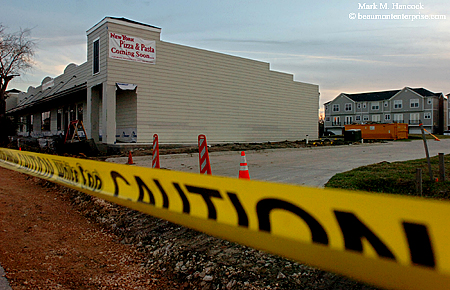
New businesses such as New York Pizza & Pasta are building near new developments to cater to downtown residents. A business complex will complete the square.

The city plans further downtown revitalization including a new event center adjacent to a proposed lake park and a waterway connecting the park to the Crockett Street Entertainment District.


Please read "New townhome, loft owners tell why..." by Colin Guy.

Ask Michael Rubenstein a question

Michael Rubenstein has been a reader and commentor on this blog for the last three years. He was a masters student at Ohio University, then freelanced at The Oregonian, but recently joined Redux Pictures and moved with his fiancee to Mumbai, India.

He's agreed to tell us about overseas photo agency work while everything is still fresh and exciting.

Leave your questions in the comment section or drop me an e-mail. I plan on asking the standard questions, but this is a chance for y'all to ask specific questions and get a specific answers about how the photo agency side of the industry works.

Please leave your questions by Sunday, Dec. 9, 2007.

Enough for now,

Michael Rubenstein

Michael Rubenstein was born in Washington D.C. on March 31, 1976. He grew up in New York and has spent most of his adult life living in Portland, Oregon.

He recently moved to Mumbai, India to cover South Asia for Redux Pictures and is available for freelance assignments.

He has a bachelors degree in Environmental Policy from Prescott College in Northern Arizona and has completed 3/4th of a Masters of Arts degree from Ohio University's School of Visual Communications. He an NPPA member.

His clients include: Time Magazine, Newsweek, The New York Times, The Wall Street Journal, The New York Times Magazine, The Oregonian, The Chicago Tribune, The Financial Times, Complex Magazine, The Paris Match, Bloomberg News Service and W+K.

He's won a several awards from the College Photographer of the Year competition and attended the Eddie Adams Workshop.

Additional images can be seen at his blog, Web site and Redux Pictures.

Please read the interview Part-A and Part-B.

Enough for now,

Monday, December 03, 2007

National Adoption Day


Mark M. Hancock / © The Beaumont Enterprise

Janisha Babbs, 2, (right) smells the corsage of her adoptive mother Linda Babbs of Beaumont (left) during the National Adoption Day ceremony at the Jefferson County Courthouse in Beaumont on Friday, Nov. 16, 2007. The annual event drew the largest response and the most adoptions since Jefferson County began celebrating the annual event.


Video © Mark M. Hancock / DFWmark.com

Marcus Bleasdale interview

Graham Holliday recently posted a short interview with the newest VII photographer Marcus Bleasdale onto the from the Frontline blog.

Enough for now,

Sunday, December 02, 2007

Ward 4 community clean up


Photos by Mark M. Hancock / © The Beaumont Enterprise

Yvonne Colon (left) with the City of Beaumont Parks Department looks up from cleaning a drainage ditch during the Ward 4 neighborhood community clean up in Beaumont on Saturday, Nov. 10, 2007.


Lamar University students (from left to right) Ify Ebede, student government president Obi Arisukwu, Dakota Doman and James Moore collect trash during the Ward 4 neighborhood community clean up.


Lamar University sophomore Kimberly Bernard, a psychology major, moves trash bags during the Ward 4 neighborhood community clean up. Neighborhood associations along with police, fire and sheriff departments worked on the project.

Use Assignment Confirmations

Most of my freelance clients have worked with me enough where my assignment confirmations consist of an e-mail stating, "Got it."

To me, "got it" means I have the assignment and agree to the usual terms. To them, "got it" means I'll do my best, turn in the assignment before the deadline, acquire required releases, and everything else required to complete the assignment to their satisfaction and get paid.

I've been at this a while, so "got it" works for me and most of my clients. We "get it." Newer clients and student PJs stepping into the pro world might not.

This is when it's appropriate to use an official Assignment Confirmation form. Technically speaking, this form is the first step in a PJ's workflow.

What's an Assignment Confirmation form?
An Assignment Confirmation form is a contract. It essentially states a publication (or commercial client) has contracted the services of a PJ to provide images. It spells out the price, rights, deadlines and other responsibilities for both parties.

If there's going to be a misunderstanding, it's much better to identify it a few minutes after the initial phone call rather than when the invoice is due.

When to use this form
If an assignment is immediate (deadline) AND with a regular client, this step can be skipped. Shoot, transmit and invoice as usual.

Otherwise, pro PJs use this form with each new client. It's a good, professional habit to always send a form when an assignment is accepted (with both new and old clients).

For newer PJs, it also acts as a focusing device while talking to a new client. By filling out the form while the client is on the phone, the PJ gets the most out of the phone call. The client knows the PJ is a professional and also gets a contract to show a supervisor.

Customer service
One advantage of this form is a customer service technique. It lets the client know the PJ is a professional, cares about the assignment and wants to get the information correct. It also establishes the business-to-business atmosphere and may yield higher payment than "standard rate," which is almost always negotiable.

For example, we expect to answer some questions and give some information when we call a cable company to have the service installed. The people we talk to are customer service representatives.

Photo buyers expect the same customer service. If they don't get this service, they may not feel as comfortable about the PJ's ability to deliver the service. We want clients to feel confident in their decision when they conclude the call. The form helps focus the conversation and follows with a written version of the conversation.

Parts of the form
Address blocks
Take a look at a blank Assignment Confirmation form. Feel free to copy and paste it into a word processor document and modify as appropriate. This is a complete form. If parts aren't necessary for a specific gig, delete those parts. However, read the notes below before it's stripped down too much.

The first section is the PJ's contact block. It lists an address and every imaginable way to contact the PJ if something goes crazy.

The second section is the client's info block. It lists how we'll contact the client in an emergency and where the images and/or invoice will be sent.

Form content
The first content section is the actual contract. It states the PJ and client made a verbal commitment and set the terms as acceptable. It also states the details of the assignment as the PJ understands the assignment (cut and paste the assignment slug if the client sends an e-mail).

The second section establishes who's who. This keeps the form flexible enough to use with multiple clients.

Amounts
Now we get to the guts of the deal. The first information we need to know is how much we're getting paid for the gig.

On the blank form provided, all blanks contain (XXX). On the actual form I use, I have real minimum amounts in these locations. If the client doesn't meet the minimum prices, our conversation is over unless it's some subject I'm salivating to shoot. If their budget is too low, I may refer them to someone who accepts gigs for less money (if the offer is insulting, I may suggest they call a day labor service).

If PJs already know their cost of doing business and Day Rate, it makes life easier. Plug these numbers into the form. Next, get the client up to the minimum numbers (or keep the PJ's mouth shut when the client offers more than an acceptable rate).

Guarantee
A guarantee is the price a PJ will be paid if nothing gets published. This is what the PJ is paid to cover time and expenses. It's often called a "kill fee." This means if the assignment is killed for any reason, the guarantee will be paid. Otherwise, PJs get the full space rate, which should be a much higher amount.

Space rates
While most newspapers pay a flat rate for shoots, several magazines pay space rates. These are amounts a magazine has budgeted per image on each page of editorial space.

In other words, legitimate magazine publishers already know how many advertising and editorial pages they'll have. They budget an amount per cover and for each inside image. Then, they find stock images or make assignments. Often this happens eight to 10 months before the publication date.

If a magazine editor calls and doesn't know how much they pay for space rate, be concerned. It means the magazine probably won't exist when it's time to pay invoices or the publication doesn't hire pro PJs often and will probably choke when you give them a legitimate price.

What's a day?
A "day rate" is how much a PJ charges for services. There are two kinds of day rates: travel and work.

Travel is a lower rate than work because nothing is produced. However, image buyers must pay for the time it takes to put the PJ in location. Otherwise, the PJ loses income because they can't accept assignments while traveling to and from the location.

The work day rate is considered any part of a day where images are produced. This means PJs have the camera out and are producing publishable images, whether published or not. This also means the PJ is using privately-owned equipment and hard-earned skills. This costs the client more.

If PJs' travel rates are too low, they must make up the difference with their work day rate. If the work day rate is too low, the PJ will be out of business soon. This benefits nobody.

Additional fees
All legitimate fees incurred while shooting are passed along to the client. These aren't expenses PJs would have if they weren't on assignment. No PJ pays a hotel, rental car or restaurant meal if they stay home. Keep the receipts and pass them along to the client.

"On stock" items are bought in bulk. Not too many years ago, we all had bricks of film and 100-sheet boxes of paper in our freezers. We purchased film and paper in bulk to keep our stock standardized (predictable results).

Now, we buy spindles of CDs/DVDs. Some folks even make prints for clients and need to calculate the cost per piece (I'll get back to this one day).

These are legitimate costs to the client. They would pay full price if the PJ didn't have these items on hand. The PJ has tested these products and found them up to standard. So, the client pays full price to get a superior product. Any difference goes toward the PJ's research and development phase. The only difference is there are no receipts to give to the client. So, they must accept the PJ's invoice as the receipt.

Due date
Most PJ work is Net 30. This means the invoice payment is due within 30 days of the date the invoice is submitted. Almost all clients pay on or before the due date (see below). The rest go into collections.

The importance of this paragraph is the establishment of interest charges for delinquent accounts. I've had at least one incident where the interest charges equated to much more than image use price. I eventually got the total due, but I would've rather gotten the fair amount on time.

The "terms and conditions" clause is the delivery memo.

Copyright
The copyright clause clearly states the PJ is the sole owner of the copyright. It also clearly states the client is buying a license to use an image. This eliminates misunderstandings.

Uses
The next paragraph lists the licensed uses. The additional statement is a formality. However, it does clarify for the uninformed that images used for self-promotion must appear in context.

Embargo
An embargo is a designated amount of time a publication has to use an image without it appearing in other publications. Spot news typically has no embargo while assignments do.

This is why it's CRITICAL for new PJs to never accept ex-post facto (after the fact) "assignments" for spot news. Publications are simply trying to secure an exclusive and limit the PJ's potential income.

The dates set are a normal embargo for an assignment. I've had clients want up to eight months, but those clients paid sufficiently for the time.

Another important embargo issue involves understanding the agreement is void if the client doesn't pay on time. It's a contract. They're contractually bound to pay by the due date. If payment isn't received, the embargo is void.

Either way, they must still pay use or kill fees, but the PJ is no longer obliged by contract to honor the embargo if the PJ has another client. This motivates most clients to pay on time.

Safe return
This confirmation form is old school. The safe return clause applies primarily to prints and chromes. Back then, it was important to get these safely returned because it was expensive to replace these images.

Now, images are mostly digital. It's far more important to ensure the images aren't "accidentally" reused without payment. I retain this clause to have leverage if something unusual happens down the road.

Credit
PJ's don't advertise in a traditional sense. Instead, our credit line ("photo by") is our advertising mechanism. While we don't particularly want our name used as a graphical device to fill space on a page, we want potential clients to see our name.

As such, our credit line has value. Publishing our images without this credit line costs us potential income, and we need to get it back. This clause sets our value of our investment and how important our advertising investment is to us.

Libel protection
Almost all publications change cutlines. Each publication has their own style and no publication wishes to be redundant (cutlines cover much of the same information for a series of images).

This clause is the PJ's protection against being involved in a libel suit because someone on the copy desk decided to be "cute" with the caption.

We accept full responsibility for our cutlines as provided. If they're modified, the publication accepts responsibility.

Several publications try to shovel libel responsibility onto PJs. It won't hold up in court, but they try.

Model releases
We've already covered model releases. If it's an assignment, get them. If it's spot news, only sell to editorial publications or get releases before selling images. Remember to charge an adequate fee for acquiring these releases and pass along model compensation fees.

This clause clearly states the PJ provides the model release rather than a client-provided release. The client's release typically only indemnifies the client and leaves the PJ hanging. In rare egregious circumstances, it tries to assign copyright to the client. Whereas the PJ's release protects both parties and places the copyright duly with the PJ.

Courtesy close
Finally, the courtesy closure gives assurance the PJ is a professional and will work diligently to provide the best images possible in a timely manner.

Enough for now,

Saturday, December 01, 2007

Lumberton Christmas Parade


Photos by Mark M. Hancock / © The Beaumont Enterprise

Deeann Cisco of Winnie, (from left to right) Carlene Fontenot and Susanne Jones, both from Orange, prepare Buddy, a 2-year-old miniature gelding, for the annual Nighttime Lighted Christmas Parade in Lumberton on Thursday, Nov. 29, 2007.


Lumberton High School wide receiver Taylor Granato (No. 9, right) helps put lights on the team float before the annual parade. Lumberton is celebrating both the holiday and the football team's first trek into the playoffs.


Lumberton Municipal Utility District maintenance technician Joel Alpers settles into his role as the Grinch before the annual Nighttime Lighted Christmas Parade.

Mark M. Hancock biography


Mark M. Hancock is Editor of books at Squadron / Signal Publications and a Dallas-based freelance photojournalist. He has been a working professional photojournalist since 1995.

His editorial work appears frequently in national and international magazines and newspapers. His commercial work appears in magazines, brochures, annual reports and billboards.

Previously, he was a staff photojournalist for for The Dallas Morning News (1996 - 2004) and The Beaumont Enterprise (2005 - 2008). His time with DMN was split between The Richardson News (1996 - 2000) and The Dallas Morning News (2000-2004).

Hancock was born in Vina Del Mar, Chile on 20 June 1965 while his father served in the U.S. Navy. He grew up in Richardson, Texas.

He later served as an infantry sergeant in the elite OPFOR (Opposing Forces) regiment of the U.S. Army at the National Training Center from 1984-1988. His military awards include an Expert Infantry Badge, Army Commendation Medal, Army Achievement Medal, Order of Hamby 1st and 3rd class, Master Tank Commander Badge, Good Conduct Medal, NCOPD ribbon, and Polar Bear Award. He qualified Expert in everything from bayonets to Dragons (wire-guided missiles).

Hancock received a Bachelor of Science degree in photojournalism with Academic Distinction from East Texas State University in 1995 and an Associates of Arts and Sciences degree with High Honors from Richland College in Dallas in 1993. While attending university, he held positions as Editor-In-Chief and News Editor of The East Texan, an award-winning independent student newspaper.

He has won many professional photojournalism awards and honors from organizations including the National Press Photographers Association, Best of Photojournalism, Society for Newspaper Design, Southern Newspaper Publishers Association, Texas Press Association, Atlanta Photojournalism Seminar, Hearst Honors, Texas Associated Press Managing Editors, Suburban Newspapers of America, Dallas Press Club and Southeast Texas Press Club.

His art pieces have been included in several juried photo exhibitions including the Art of Digital Photography show, Texas Photographic Society - Governor's Exhibition, Texas Visual Arts Association Citation Awards and Dallas Business Council on the Arts show as well as other solo and group shows.

He has judged many professional photography contests including National Press Photographers Association national clip competitions, Portfolios.com annual Pcom Awards as well as numerous national, regional and local photography contests.

Hancock was a primary contributor to the book "Rita Captured." The book, published by The Beaumont Enterprise, presents a visual timeline of the destruction caused by Hurricane Rita in Southeast Texas and Southwest Louisiana. The book won a Katie Award.

In 2007, he started producing news videos and music for Web presentations. Hancock also accepts speaking engagements. Most recently, he made two presentations for the New York Press Association annual spring convention.

Hancock met his wife Fayrouz, a Chaldean-Iraqi-Australian-American, online while he lived in DFW and she lived in Sydney, Australia. After cyber-dating for more than a year, they finally met, got engaged and eventually married in 2001. They currently live in Frisco, Texas and have no children.

Examples of his work can be seen on PhotoJournalism, his award-winning blog.

Enough for now,

Friday, November 30, 2007

Kirbyville VIPs


Mark M. Hancock / © The Beaumont Enterprise

Kirbyville's quarterback Aaron Hazlewood (left) and receiver Randy Musgrove (right) pose for a portrait at Kirbyville High School in Kirbyville on Tuesday, Nov. 27, 2007. The duo have helped push the team deeper into the playoffs.

Thursday, November 29, 2007

Boys to Men dinner


Photos by Mark M. Hancock / © The Beaumont Enterprise

Mark Daire, Jr., 14, (left) and his father Mark Daire, Sr. (right) listen to the featured speaker during the Boys To Men program at Central High School in Beaumont on Wednesday, Nov. 7, 2007.


Guests listen to introductions during the Boys To Men program at Central High School in Beaumont. The program seeks to pair young men with positive role models within their family, the school or community.


Jacob Kennebrew, 4, works on his engineering skills with plastic forks during the Boys To Men program at Central High School in Beaumont.

Please read, "Central introduces mentoring program for boys" by Dee Dixon.

Wednesday, November 28, 2007

Bruins go into hibernation


Photos by Mark M. Hancock / © The Beaumont Enterprise

West Brook sophomore Stephen Young plays a Sousaphone under the stands before the Class 5A Division II area-around playoff game against Fort Bend Clements in Houston on Saturday, Nov. 24, 2007.


West Brook's Christine Michael (No. 33, center) drags Fort Bend Clements' Kyle Hoke (No. 7, bottom) as Dylan Thorwaldson (No. 25, left) moves in to assist during the playoff game. Michael rushed 20 times for 175 yards and three touchdowns during the game.


West Brook's Joshua Powdrill (No. 2, center) powers for yards during the playoff game against Fort Bend Clements.


West Brook fans Karen and Chuck Sayles of Beaumont cheer for the Bruins during the playoff game against Fort Bend Clements. The Bruins held a 12-point advantage during part of the 4th quarter.


West Brook's Jordan Garrett (No. 4, left) bobbles the ball as he's hit by Fort Bend Clements' Dylan Thorwaldson (No. 25, right) during the Class 5A Division II area-around playoff game in Houston. West Brook lost the game 36-33 and is finished for the season.

Tuesday, November 27, 2007

Central Medical Magnet students


Mark M. Hancock / © The Beaumont Enterprise

Central Medical Magnet High School seniors Adriana Gomez (right) and X'alexis Rawlins (left) share lunch and conversation during a visit from Ugandan representatives at the school in Beaumont on Tuesday, Nov. 13, 2007. The vice president of Uganda is a medical doctor and sent representatives to arrange exchange students in America.

Monday, November 26, 2007

Takin' down LaMarque


Photos by Mark M. Hancock / © The Beaumont Enterprise

Lumberton High School junior Ashley Mauer (right) paints the face of Brandtley Matthews (left) before the Lumberton Class 4A Division II playoff football game against LaMarque in Baytown on Friday, Nov. 23, 2007.


Lumberton's Jacob Hanna (No. 24) runs back a kick during the playoff football game against LaMarque. Hanna scored one Raider touchdown.


Lumberton's Cody Hussey (No. 5) runs for his second touchdown during a playoff football game against LaMarque. Hussey accumulated 267 rushing and receiving yards during the game.


Lumberton's Jacob Hanna (No. 24, right) puts pressure on LaMarque's Jarius Kerlegan (No. 18, left) during the Class 4A Division II playoff football game in Baytown. Lumberton won 24-21 and moves to the regional final.

Sunday, November 25, 2007

Lawn decor


Photos by Mark M. Hancock / © The Beaumont Enterprise

John Hughes installs an "Eight maids a-milking" lawn ornament at his parents' home on Thomas Road in Beaumont on Wednesday, Nov. 21, 2007.


John Hughes installs parts of the "Six geese a-laying" lawn ornament at his parents' home on Thomas Road. Hughes's and his wife Sharon have hand-design and presented a new ornament of the 12 Days of Christmas to his parents for the last 10 years.


John Hughes installs the "Nine ladies dancing" lawn ornament section at his parents' home on Thomas Road in Beaumont. The newest addition, "10 lords a-leaping" will be added this Christmas.

Saturday, November 24, 2007

Kelly finale


Photos by Mark M. Hancock / © The Beaumont Enterprise

Kelly's Donnie Carona (No. 9) waits on the kickoff during a first-round TAPPS Division I playoff game against Fort Worth Nolan at Kelly High School in Beaumont on Saturday, Nov. 17, 2007.


Kelly's Anthony Fazio (No. 7) throws a pass during a playoff game against Fort Worth Nolan Catholic at Kelly, also a Catholic high school.


Kelly quarterback Anthony Fazio (No. 7, center) gets surrounded by Fort Worth Nolan players during a football playoff game at Kelly High School.


Kelly's Donnie Carona (No. 9, right) gets hit by Fort Worth Nolan's Michael Shields (No. 6, left) during a playoff football game.


Kelly's Donnie Carona (No. 9, left) dives for a touchdown and is facemasked by Nolan's John Phillip Boudreaux (No. 8, right) during a TAPPS playoff game at Kelly High School in Beaumont. Kelly entered the game undefeated for the season.


Fort Worth Nolan's John Phillip Boudreaux (No. 8, left) strips the ball from Kelly's Donnie Carona (No. 9) as Nolan's Michael Shields (No. 6, right) makes a hit during a first-round TAPPS playoff football game at Kelly High School in Beaumont. Kelly lost the game 28-24 and was eliminated.