Monday, October 03, 2011

Downtown Dallas lighting


Mark M. Hancock / © DFWmark.com

Lighting illuminates part of the downtown Dallas skyline over the Arts District in Dallas on Sept. 29, 2011.


Sunday, October 02, 2011

Rangers vs. Tigers baseball


photos © Mark M. Hancock and The Dallas Morning News Rangers' catcher Mike Napoli (25) tags out Tigers' Danny Worth (29) at the plate during a Major League Baseball game at Rangers Ballpark in Arlington on June 7, 2011. See a larger version of this slideshow. The Texas Rangers battle Detroit's Tigers during a Major League Baseball game at Rangers Ballpark in Arlington. Both teams eventually advanced to the current division series. Named in this slideshow are:   Mike Napoli, Danny Worth, Josh Hamilton, Austin Jackson, Mitch Moreland, Casper Wells, Brennan Boesch, Miguel Cabrera, Mike Maddux, Matt Harrison, Ron Washington, Ed Hickox, Dave Bush, Ian Kinsler, Jhonny Peralta, Ryan Raburn, Mark Lowe and Yoshinori Tateyama.

Know Your Rights

U.S. PJs take media law courses in college to learn their rights and responsibilities. In the past, I've considered it redundant to post this information on this blog.

However, after a particularly annoying incident today in a public park, I've determined many people are either ignorant or are just control freaks. So, here is a link to the ACLU's "Know Your Rights" post for photographers (it covers the same information posted in 2005).

In general, if you are standing on public property and not impeding emergency or police activities, you can shoot whatever you can see. It's a Constitutional right for every person standing on U.S. public property. There's no debate.

If you don't want photos of yourself or your objects, don't be within plain sight of public property. The Constitution is the basis for - and thereby trumps - all other laws.

Enough for now,

Saturday, September 10, 2011

FC Dallas vs. Revolution soccer


photos © Mark M. Hancock and The Dallas Morning News

FC Dallas' Marvin Chavez (18) leaps over the diving save of Revolution goal keeper Matt Reis (1) during a Major League Soccer match at Pizza Hut Park in Frisco on June 4, 2011.


See a larger version of this slideshow.

FC Dallas battles the New England Revolution during a Major League Soccer match at Pizza Hut Park in Frisco. FC Dallas won the match 1-0 over New England.

Named in this slideshow are:   Kevin Alston, Brek Shea, Marvin Chavez, Didier Domi, Matt Reis, Eric Alexander, George John, Ryan Cochrane, AJ Soares, Fabian Castillo, Andrew Jacobson and Stephen McCarthy.

Tuesday, September 06, 2011

Waxahachie vs. Frisco Wakeland soccer playoff


Waxahachie senior Caroline Clifton (18) braces to be hit by the ball as Fisco Wakeland junior Katey Carmichael (2) tries to pass to sophomore Maddie Lundberg (14) during a high school playoff soccer game at Standridge Stadium in Carrollton on April 8, 2011.


photos © Mark M. Hancock and The Dallas Morning News


See a larger version of this slideshow.

Waxahachie battles Fisco Wakeland during a high school soccer playoff game at Standridge Stadium in Carrollton.

Named in this slideshow are: &nbsp Katey Carmichael, Tierney Thomison, Jennifer Perry, Caroline Clifton, Ashley Kingston, Maddie Lundberg, Kourtney Holleman, Danielle Tesei, Bridget Reid, Sarah Hay, Christine Sparks, Karleigh Hector, Lexie Devore, Ashley Vega and Natalie Kelly.


Sunday, August 28, 2011

Skyline vs. Jesuit basketball


Skyline's Zach LeDay (32) aggressively blocks the shot of Jesuit's Jeff Schoettmer (11) during a high school basketball game at Jesuit High School in Dallas on Feb. 7, 2011.


photos © Mark M. Hancock and The Dallas Morning News


See a larger version of this slideshow.

Skyline battles Jesuit during a high school basketball game at Jesuit High School in Dallas on Feb. 7, 2011.

Named in this slideshow are: &nbsp Blake Vierling, Will Barrow, DeVante Kincade, Zach LeDay, Jeff Schoettmer, David Lacey, Stephen Spieth, Shirmane Thomas, Will Thompson and Stephen Olson.


Thursday, August 25, 2011

Flower Mound Marcus vs. Plano basketball


Flower Mound Marcus junior A.J. Luckey (11) leaps before Plano senior Julian Okoro (4) during a high school basketball game at Marcus High School in Flower Mound on Jan. 4, 2011.


photos © Mark M. Hancock and The Dallas Morning News


See a larger version of this slideshow.

Flower Mound Marcus battles Plano during a high school basketball game at Marcus High School in Flower Mound on Jan. 4, 2011.

Named in this slideshow are:   Terrance Cooper, Connor Taggart, Nick Banyard, Dwayne Hicks, Clayton Parlin, Austin Bianco, A.J. Luckey, Julian Okoro, Phillip Forte and Marcus Smart.


Saturday, August 20, 2011

Woodrow Wilson vs. Melissa hoops playoff


Woodrow Wilson junior Andre Plata (33) and Melissa freshman Jackson Webb (13) dive for a loose ball during a high school basketball playoff game at Ellis Davis Field House in Dallas on Feb. 19, 2011.


photos © Mark M. Hancock and The Dallas Morning News


See a larger version of this slideshow.

Woodrow Wilson battles Melissa during a high school basketball playoff game at Ellis Davis Field House in Dallas. Woodrow Wilson won 68-53 and advances.

Named in this slideshow are:   Justin Daniels, Hondo Webb, Ian Hatfield, Andre Plata, Zach Helmberger, Ryan Ragon, Dearius Wright, Michael Vickers, DJ Brown and Jackson Webb.


Monday, August 08, 2011

PJ Challenge Competition

One hard-working PJ/reader is about to EARN an Urban Disguise 50 V2.0 laptop/camera bag valued at $179.

In honor of this blog’s 2 millionth milestone (not really, but it’s a happy coincidence), the good people at Think Tank Photo have offered the rockin' prize posted above.

Rather than a regular (subjective) PJ contest for the best quality images, this contest is for hard-working PJs. Let’s reward the PJ who works the hardest on all the subjects a PJ should do each week.

A shopping list of PJ subjects is posted below. To win this prize, a PJ must be the first to shoot and post links to ALL of the subjects*.

* Rules:
1) The subjects must be shot on or after August 9, 2011.
2) All photos, videos, slideshows and captions must be posted to publically-viewable locations on the Web (newspaper website, blog, portfolio websites, etc.). The spot news photo MUST be on a news site (it must be vetted by an editor).
3) PJ must shoot and post links to ALL subjects listed below. Simply cut-and-paste the list into the comments section and add a link to EACH example of YOUR work. Each subject and/or link may only be entered in one category below. Only entries submitted as comments for this post will be considered (no e-mail).
Again, contestants can only enter ONE entry in the comment section of this post with ALL subjects and links in the ONE post. The post should have exactly 13 links.
4) Each image link must have an appropriate photo(s) and/or video for the category and a complete cutline (names, dates, locations, etc.).
5) All entries will be time-stamped by Blogger when the entry is submitted. The first to complete the PJ challenge wins.
6) Once a winner is determined, the winner must be willing to e-mail their personal information to me for Think Tank Photo to mail your prize.
7) Mark M. Hancock is only responsible for verifying the completion of this challenge. The winner is subject to any additional rules required by Think Tank Photo (I don’t think there are any, but I’m covering all bases).
8) PJ's only provide links to the images/videos as evidence. Copyright owner(s) keeps all rights.

Please see the Labels section of this blog to clarify terms.

Categories
Please provide a link to ALL of the following:

1) Spot news (must be a news link rather than personal site)
2) General news
3) Sports
4) Feature photo
5) News photo story (three photo minimum)
6) Feature photo story (three photo minimum)
7) Concert or theater
8) Education
9) News or business portrait
10) Wildlife
11) Product photo (a restaurant review is fine)
12) Slideshow
13) Video

Good luck and get to work.

Enough for now,


Rock Climbing as a whole-body exercise


photos © Mark M. Hancock and The Dallas Morning News

Kirk Taylor of Dallas scales a wall during a climbing session at Exposure Indoor Rock Climbing in Carrollton on June 23, 2011.


See a larger version of this slideshow.

Climbers get a workout and staff demonstrate additional exercises at Exposure Indoor Rock Climbing in Carrollton. Rock climbing provides a whole-body workout for participants.

Named in this slideshow are: &nbsp Tadd Jensen, Kirk Taylor, Paul Soutner, Chris Castrianni, Pat Roscovius, Kit Sinclair and Zach Marsh.

Please read "Rock climbing offers workouts for all body types" (subscription required) by Caitlin Johnson / The Dallas Morning News.


Sunday, July 31, 2011

Southlake Carroll spring football game


Tyler Barnes (8) breaks up a near interception by Jeremy McClellan (2) during the Southlake Carroll High School spring football game at Dragon Stadium in Southlake on May 26.


photos © Mark M. Hancock and The Dallas Morning News


See a larger version of this slideshow.

The Southlake Carroll High School football team plays during the annual spring football game at Dragon Stadium in Southlake on May 26.

Named in this slideshow are: &nbsp Sabian Holmes, Kenny Hill, AJ Ezzard, Tyler Barnes, Jeremy McClellan, Nick Melocik, Ben Sego, Jackson Mitchell, Kyle McKinney, Dillon Rake, Matt Swoyer, Sean Dickson, Hal Wasson and Tyler Hunter.


2 Million page views

Thanks to everyone for helping this blog achieve more than 2 million page views. It was never expected, but is appreciated.

Enough for now,

Saturday, July 30, 2011

Cedar Hill spring football game


photos © Mark M. Hancock and The Dallas Morning News

Jared Rayford (4) looses track of a pass during the Cedar Hill spring football game at Longhorn Stadium in Cedar Hill on May 27, 2011.


See a larger version of this slideshow.

The Cedar Hill football team plays spring football game at Longhorn Stadium in Cedar Hill.

Named in this slideshow are: &nbsp Jamal Patterson, Andre Anderson, Leon Fulgham, Chris Coffer, Jeantavus White, Isaiah Lewis, JC Franklin, Quincy Adeboyejo, Nik Crist, Dashune Barlow, Travis Wilson, Laquvionte Gonzalez, Dashune Barlow, Jared Rayford, Evan Williams and David Harris.


Thursday, July 21, 2011

"Shooting Star" performance


photos © Mark M. Hancock and The Dallas Morning News

Reed McAllister, played by James Crawford, meets his former lover Elena Carson, played by Diana Sheehan, in an airport during a performance of "Shooting Star" at the WaterTower Theatre in Addison on May 28, 2011.


See a larger version of this slideshow.

Reed McAllister, played by James Crawford, meets his former lover Elena Carson, played by Diana Sheehan, in an airport during a performance of "Shooting Star" at the WaterTower Theatre in Addison.


Saturday, July 09, 2011

Submit photos for publication

Editor's note: This piece was written for a military vehicle magazine. It's written primarily for vehicle owners who want to submit photos of their personally-owned military vehicles for publication. However, most of the suggestions apply to all photographers.

© By Mark M. Hancock for Supply Line magazine

Professional images in newspapers, magazines and books have several commonalities. First, they’re sharply focused. They are properly exposed. They have some element of timing or time (including timelessness). They have good composition. Most importantly, they contain enough information for reproduction in the medium.
How large a photo can run (be reproduced) is determined by the final file size. This size is determined by the capture size minus any crops. While film can be scanned at higher resolutions, there is no way to “add” size to a digital photo. Once a digital image is made, it can only be degraded. Consequently, it’s vital to capture images at the highest resolution possible.
Television promotes a misconception that images can be “enhanced” beyond the original. This is false. An original image cannot be improved or repaired. Color balance, saturation, contrast and definition can be adjusted, but the information contained within the image is set.
The highest quality any image will ever produce is determined at the exact moment the shutter is activated. Furthermore, each step away from this original is an opportunity for the image to be degraded.
Professional digital cameras capture images in the most direct-to-press method. However, not all digital cameras are alike, and sometimes it’s better to use quality film cameras rather than inferior digital cameras.
When film is used, it’s best to scan directly from a negative or transparency. This process ensures the image is close to the original source. If the image was shot on film, printed onto paper, and scanned into a computer, the image is already at its third generation.
A grandson may look similar to his grandfather, but it’s not the same person. Only the original is the original.
The fidelity of the image becomes most important when it is submitted for publication.
Each print medium has a set pixel per inch (ppi) requirement. Newspapers are often 200 ppi, magazines and books can be 400 ppi. By comparison, most computer monitors are 72 ppi. Consequently, an image may look fine on a home computer monitor, but it wouldn’t look good in print.


This image of a retired M41 Bulldog was made with a Nikon D300 digital camera at a medium-fine setting. The quality is good enough for newspaper publication.


This image the same M41 Bulldog was made with a iPhone 4. The quality is surprisingly good enough for newspaper publication. However, it has major limitations.

Get published

Publications most often reject submissions because the images lack enough information or clarity for reproduction. There are several steps photographers can take to get their images published.
* All images start or fail with the quality of the lens. It doesn’t matter how large an image is if it was shot through a dirty fishbowl. Cheap cameras have cheap, plastic lenses. Likewise, quality cameras can have quality lenses. The quality of the lens determines the sharpness of the photo.
The sharpness of a photo is determined by the “circles of confusion” it produces. Lenses that produce the smallest circles of confusion are the best.
* The camera itself plays a significant roll in image quality. With film, it’s less important to have a top-end camera as long as the “glass” (lens) is good. With digital cameras, the camera, its sensor and internal processing software are often the difference between instant success or failure.
It is vital that a camera doesn’t artificially increase the file size. All digital cameras interpolate to some degree to make digital images. However, cameras that immediately increase the number of pixels, have also immediately destroyed the image fidelity because more of the image is fiction than reality.
The camera adds extra pixels and “guesses” about the pixel colors between other pixels and most often averages surrounding pixels. The average between red and blue is magenta (bright pink). Magenta is not a great color for a combat vehicle.
Professional cameras have better software algorithms and more sensors to capture an image with minimal immediate destruction.
Some micro and cell phone cameras are starting to achieve significant gains by reducing the size, but increasing the number of sensors. However, they still aren’t up to the same professional standard, nor are they anywhere near professional-quality film.
* Crops play an equal role in the ultimate size of an image. A crop reduces the area viewed in an image. There are three basic crops. These are camera, software and presentation crops.
Camera crops are perfectly acceptable. The photographer simply moves around or changes lenses to isolate a specific scene. These images reproduce best because no information is lost between the shoot and publication.


Both of these images were made seconds apart with the same professional camera. The top image was not cropped. The bottom image was cropped and artificially enlarged. Professional shooters get close for detail shots.


Never use the “digital zoom” or “digital crop” software built into some consumer cameras. The camera automatically discards the excess information rather than expanding the number of sensors used to collect the image. Instead, get closer to the subject rather than throwing away those valuable pixels.
Software crops are a deliberate decision to discard valuable image real estate. If the camera was tilted, the photographer was too far away from a subject or other visual elements intrude into the frame, it’s common to crop the image in digital photo software.
Publications often have formats for specific types of images. Oddly-shaped images will often suffer crops to fit these parameters. Even if the publication accommodates odd-shaped images, the editor may choose to crop “extraneous” elements out of an image to make the main subject more noticeable.
All of these crops reduce the effective size of a digital file. When an image is 192 megabytes (Mb), such as many color Library of Congress photos from the 1940s, crops have little effect on the ability to publish an image. However, a 5 Mb image can’t take a severe crop and still be large enough for use in most magazines.
* Camera stability helps determine the sharpness of an image. Without getting too technical, greater light allows for better images through faster shutter speeds, lower film speeds and more depth of field. Low light has the opposite effect.
Camera shake is a direct result of an unstable camera. With low light, camera shake is inevitable unless a sturdy tripod or other platform is used. While it isn’t foolproof, a good tripod is the single most valuable tool a photographer can use to improve image quality.
* Interpolation is an artificial increase of a digital file’s size. As mentioned above, this can happen as the image is captured. It can also happen by well-intentioned people increasing the size of a file to make it fit a publication’s parameters.
Unfortunately, interpolation can also make images completely useless to publishers. Many publishers have specialized software and camera techniques to slightly increase the usable size of an image. However, the increases are limited and also amplify any image flaws. A larger, flawed image is simply a bigger mess.
Most software is capable of increasing file sizes. If it can be avoided, DON’T ARTIFICIALLY INCREASE FILE SIZES. While the software is helpful, it isn’t as good as a full-size original because it artificially increased the file size. Specialized programs still invent “stuff between stuff,” but it does so better than other software programs.
Many publishers can scan prints and film at resolutions as high as 9,600 ppi to ensure clarity. However, if an image was already degraded (via previous artificial increases or other software manipulations) before it gets to a publisher, nothing can be done to salvage the image.
Photographers submitting scans to publications need to maximize every scanner setting to acquire the highest resolution image possible. There is no such thing as an image that is too large to publish. It takes much longer to make several high-resolution scans, however, each second spent on the scanner is more than equally rewarded on the press.
It’s wisest to spend the same time tightly editing which photos will be submitted rather than scanning and submitting many low-resolution images. The low-res images won’t be used and wastes an editor’s time.
In short, no program “improves” images by making them larger, artificial increases only degrade images. It’s best to get the original capture medium (film, digital file, etc.) and work forward from there. Then, scan the original at the largest file size possible and run it in a location smaller than the actual file size.

Historic images


German plane C.L. III A 3892/18 was brought down in the Argonne by U.S. machine gunners, between Montfaucon and Cierges, France on October 4, 1918. (Pvt. J. E. Gibbon / U.S. Army)

While photographers have complete control over the quality of their own images, sometimes historic images are needed to completely tell a story.
The most important issue when submitting images to a publication in the U.S.A. is ownership of copyright. In the United States, the person submitting the images must either have made the images, have reproduction permission from the copyright owner, or have acquired an explicit “public domain” image (from a governmental organization).
The image above is an example of a public domain image acquired through the U.S. Department of Defense official internet site (www.defenseimagery.mil). It was made by Pvt. J. E. Gibbon for the U.S. Army in 1918. It is a 1.1Mb scan of a print from a film camera.
Additionally, it illustrates that high-resolution historic images are available from the Civil War to present day.
Unfortunately, the digital image above has also been manipulated by someone along the line and would be rejected by most newspapers and magazines as a credible image. However, it illustrates today’s topic while image manipulation is a subject for another day.
Recently, photographers (and other copyright owners), have voluntarily elected to allow their private images to become part of the public domain through Creative Commons agreements (www.creativecommons.org). While there are various licensing agreements within this range, many photographers have released all claims to images.
However, most publicly accessible photos on the internet are protected by copyright and permission must be acquired to use them. Without getting too deep into media law, here are some copyright basics.
The second a photographer makes an image, it’s protected by copyright. Nobody else can use or has any claim upon the image (latent or digital) unless the photographer has expressly given his or her rights to another person or entity. Professional photographers generate income and perpetuate their profession by leasing limited reproduction authority.
Some employees of several companies automatically surrender this copyright to the company while working on the behalf of the company (such as news organizations or military manufacturers).
When displaying an image in public, there is no legal requirement to notate an image as copywritten. Through its existence, it automatically has a copyright. Smart photographers also file for an explicit (hard) copyright through the U.S. Copyright Office (www.copyright.gov) to collect additional punitive damages for infringement, but it isn’t required by law.
There are always exceptions concerning image ownership, but it’s best to ask before assuming ownership or availability of images.
Furthermore, possession of an image (in print or digitally) doesn’t equate to ownership. The purchase of a print or digital file doesn’t equate to ownership. Only original creation, signed reproduction permission or verifiable public release of an image allows others to legally publish images.

Online images

Another issue with images found online is file size.
Images posted online are expected to be viewed on 72 ppi monitors. Furthermore, designers want pages to load rapidly to keep the attention of visitors. When both of these demands collide, low-resolution images will be used.
An image that appears to be 5.5 inches on a computer monitor may only reproduce at 1 inch in a magazine due to the ppi conversion. Therefore, it’s imperative to ask image owners for high-resolution images while getting publication permissions.
Digital processing of photos is a relatively new process. Although the first digital camera was created in 1975, almost all images made before the 1980s should have been made on film. If a low-resolution image exists, a high-resolution image or original document (negative, slide or even a print) should also be available.
Again, it’s best to use the original source materials to get the best reproduction materials at the highest resolution to meet any dimensional requirements.
Image dimensions are expressed in various terms. The actual number of pixels an image contains is fixed until it is cropped. A 4,000-pixel-wide image remains 4,000 pixels wide even if the file format or image resolution is changed.

Understand megabytes (Mb)


The image above is a tightly cropped version of an iPhone 4 photo. It held up better than expected when compared to images from a professional camera. However, the dynamic range (steps between white and black) doesn’t have the same quality, nor does it have the same overall .jpg file size or color clarity as its competition.


Some publishers prefer to receive images with specific pixel minimums (photographers are welcome to exceed this number). This ensures an image will fit into a “hole” on a page. Unfortunately, if a crop is needed for proper display, a just-large-enough image could be rejected.
Other publishers prefer to have a minimum megabyte count. While megabytes of information ultimately determine if an image has enough information, various factors play into an image’s megabyte size.
The camera determines the file size. Cameras are sold based on megabyte (Mb) count. In theory, an 8Mb camera should make a better image than a 3Mb camera. However, this could be an illusion.
If the camera artificially increases the file size to get a larger Mb file, the images are largely useless. Furthermore, if the camera’s lens or other optical qualities are inferior, no Mb count is going to make it better. A 100Mb image shot through a dirty goldfish bowl is the same as a 1K image to a publisher. Neither will run.
Additionally, file formats increase and decrease Mb count.
Joint Photographic Experts Group (JPEG or .jpg) images are the most common photo compression format. It compresses the file size to its smallest possible size to save computer space and speed movement from machine to machine. These images can also move freely among various software programs.
However, each compression creates a loss of information. Publishers prefer .jpg images to move directly from a camera to a pre-press operator. The direct route limits number of Saves (and image compressions).
The next type of file is a Tag Image File Format (Tiff or .tif). Tiffs are more “change friendly” because it doesn’t compress and lose information on each Save. Tiff images tend to be four times as large as .jpg files. Consequently, if a publisher requires 5Mb .jpg images, the Tiff equivalent would be 20Mb.
The largest common file format is Encapsulated PostScript (EPS or .eps). This is actually a vector format designed for graphic artists. Because photos are pixel-based (raster), it’s not an ideal format for photographs. However, it creates a large, loss-free image file. It’s best to avoid this format.
A 5Mb .jpg image can save as a 28 Mb .eps file. This is essentially a temporary size illusion because the file will be converted to a .jpg or .tif file by the publisher. When a publisher requires a 5 Mb .jpg, a 5 Mb .eps won’t work.


Photographers should also remember to make vertical images and move around to get multiple angles of the same subject to show the environmental context. The results may reveal something unexpected.


Enough for now,
 

Tuesday, July 05, 2011

Rockwall-Heath vs. Waxahachie baseball playoff


photos © Mark M. Hancock and The Dallas Morning News

Rockwall-Heath's Jake Bledsoe (34) stops a scoring attempt by Waxahachie's Alec Johnson (7) during a high school baseball playoff game at Richards Park in Waxahachie on May 28, 2011.


See a larger version of this slideshow.

Rockwall-Heath battles Waxahachie during a high school baseball playoff game at Richards Park in Waxahachie on May 28, 2011.

Named in this slideshow are:   Kyle McLeroy, Jake Bledsoe, Jeremy Escobar, Cameron Phillips, Timbo Duncan, Tracy Wood, Alec Johnson, Ryan Cawthon, Blake Brown, Trent Armstrong, Greg Harvey, David Martinelli, Cody Brown, Grayson Lewis and Caleb Copley.


Monday, July 04, 2011

Happy Independence Day


© Mark M. Hancock and The Dallas Morning News

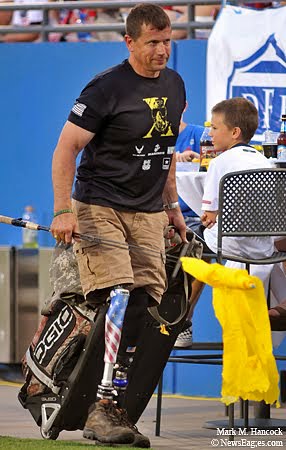
Double amputee retired Sgt. 1st Class Dana Bowman parachutes into Pizza Hut Park with the United States flag before the FC Dallas and Columbus Major League Soccer match in Frisco on July 2, 2011.


Retired Sgt. 1st Class Dana Bowman moves his jump equipment from the pitch to sign autographs during the FC Dallas and Columbus Major League Soccer match at Pizza Hut Park in Frisco.


Wednesday, June 29, 2011

Stars vs. Canadiens hockey


photos © Mark M. Hancock and The Dallas Morning News

Stars goalie Kari Lehtonen (32) blocks a shot from the Canadiens during an NHL hockey game at the American Airlines Center in Dallas on Dec. 21, 2010.


Stars captain Brenden Morrow (10) plays against the Montreal Canadiens despite a broken nose during an NHL hockey game at the American Airlines Center.


Stars Brian Sutherby (20) and Canadiens P.K. Subban (76) fight during an NHL hockey game in Dallas.


Stars Brian Sutherby (20) throws Canadiens P.K. Subban (76) to the ice during a fight at an NHL hockey game at the American Airlines Center.


Stars Jamie Benn (14) scores a goal against Canadiens goalie Carey Price (31) as Josh Gorges (26) approaches during an NHL hockey game in Dallas.


Stars Jamie Benn (14) and Stephane Robidas (3) celebrate Benn's goal against the Canadiens during an NHL hockey game in Dallas.


Stars goalie Kari Lehtonen (32) saves a shot on goal by Canadiens Max Pacioretty (67) as Jeff Woywitka (44) follows during an NHL hockey game at the American Airlines Center in Dallas.


Sunday, June 12, 2011

TAPPS Division I state semifinal playoff


photos © Mark M. Hancock for The Texas Catholic

Bishop Lynch senior quarterback Mark Czaus (8) passes the ball to junior Matthew Duerr (29) as he's tackled by Prestonwood Christian's junior Anthony Morgan (12) during a TAPPS Division I state semifinal playoff game at Standridge Stadium in Carrollton on Saturday, Nov. 27, 2010.


See a larger version of this slideshow.

Bishop Lynch battles Prestonwood Christian during a TAPPS Division I state semifinal playoff game at Standridge Stadium in Carrollton on Saturday, Nov. 27, 2010.

Named in this slideshow are: &nbsp Olivia Cannon, Kevin Sparkman, Jacob Reimer, Mark Czaus, Matthew Duerr, Nick Wurst, Parker Ash, Zac Grogean, Kevin Huffaker, Brennan Beeson, Jonathan Mora, Jordan Airhart, Christian McLain, Frank Vecella, Riley Standridge, Brendan Dull and coach Bill Persinger.

Sunday, June 05, 2011

SMU graduation ceremony


Philip Gustaf Klintmalm dances across the stage as he gets his geology degree during the Southern Methodist University December Graduation Ceremony at SMU in Dallas on Dec. 18, 2010.


photos © Mark M. Hancock and The Dallas Morning News


See a larger version of this slideshow.

Scholars get their degrees during the Southern Methodist University December Graduation Ceremony at SMU in Dallas on Dec. 18, 2010.

Named in this slideshow are:   Bhavesh Patel, Dhruti Patel, Christy Sauceda, Lisa Mandac, Jason Feinglas, Garrett Moran, Paul Cunningham, Stephen Jake Torres, Paul W. Ludden, R. Gerald Turner, Abdulaziz Yousf Bahha, Ali Akbar Moslemi, Stephanie Susan Fischer, Caren H. Prothro, Lo Ting Wu and Philip Gustaf Klintmalm.


Wednesday, June 01, 2011

South Garland vs. Longview football playoff


photos © Mark M. Hancock and The Dallas Morning News

South Garland seior T.J. Hill (15) reaches for a pass as Longview senior Brian Tomlinson (3) defends during a second-round playoff football game at Kincaide Stadium in Dallas on Nov. 20, 2010. Longview won the game 27-14 and advanced.


See a larger version of this slideshow.

South Garland battles Longview during a second-round playoff football game at Kincaide Stadium in Dallas.

Named in this slideshow are: &nbsp Dakota Anthony, Rashad Austin, J'Haston Faggans, Ladarrin Robertson, Eric White, John Lacour, Kevitric Fields, Stephan Turner, Anthony Wiley, Jaylon Porter, Bontavius Davis, T.J. Hill, Brian Tomlinson,


Monday, May 30, 2011

Even if we lose, we win

Miami Heat forward Chris Bosh returns to Dallas as a star to challenge the Mavericks for the NBA title. No matter which team wins the championship, Dallas wins.


Mark M. Hancock / © The Dallas Morning News

The future location of Chris Bosh and his basketball career is in the air as the longer-than-the-family-sofa NBA draft prospect poses for a portrait at his home in Lancaster on Sunday, June 22, 2003.


NBA draft prospect Chris Bosh (center) shares a laugh with his parents Noel (left) and Freida (right) at the family's home in Lancaster. Bosh is a former Lincoln High School basketball star. He is entering the NBA draft after his freshman season at Georgia Tech.


NBA draft prospect Chris Bosh poses with his 17-year-old brother Joel (left) during a portrait session at the family's home in Lancaster.


NBA draft prospect Chris Bosh (right) laughs as his 17-year-old brother Joel (left) hides following his own joke at the family's home in Lancaster.


Sunday, May 22, 2011

Mavericks vs. Phoenix basketball


Dallas' Dirk Nowitzki (41) looks to make a move around Phoenix's Grant Hill (33) during an NBA basketball game at American Airlines Center in Dallas on April 10, 2011.


photos © Mark M. Hancock and The Dallas Morning News


See a larger version of this slideshow.

Dallas battles Phoenix during an NBA basketball game at American Airlines Center in Dallas.

Named in this slideshow are:   Dirk Nowitzki, Steve Nash, Grant Hill, Jared Dudley, Rodrigue Beaubois, Tyson Chandler, Peja Stojakovic, Vince Carter, Josh Childress, Rick Carlisle, Corey Brewer, Jose Juan Barea, Aaron Brooks, Hakim Warrick, Robin Lopez, Jason Terry, Brendan Haywood, Shawn Marion and Garret Siler.


Wednesday, May 18, 2011

Mavericks vs. Raptors basketball


Mavericks' DeShawn Stevenson (92) looks for an opening in Toronto's defense during an NBA basketball game at American Airlines Center in Dallas.


photos © Mark M. Hancock and The Dallas Morning News


See a larger version of this slideshow.

The Dallas Mavericks battle Toronto during an NBA basketball game at American Airlines Center in Dallas on Dec. 28, 2010.

Named in this slideshow are:   Dirk Nowitzki, DeShawn Stevenson, Shawn Marion, Amir Johnson, Jason Kidd, Jerryd Bayless, Caron Butler, Jason Terry, Ed Davis, DeMar DeRozan, Jose Juan Barea and Julian Wright.

Monday, May 16, 2011

Healthy gifts


Brian Brown of Dallas poses for a portrait at Premier Park in Balch Springs on Nov. 21, 2010.


photos © Mark M. Hancock and The Dallas Morning News


Brian Brown of Dallas plays during a league soccer game at Premier Park in Balch Springs. Sporting equipment makes excellent gifts for athletes of all ages.


Brian Brown of Dallas, left, kicks a ball during a league soccer game at Premier Park. From shin guards and cleats to helmets, a variety of specialized equipment is required for each sport.


Brian Brown of Dallas defends during a league soccer game at Premier Park in Balch Springs.


Sunday, May 15, 2011

Celina vs. Lovejoy 3A Div. 1 Playoff


photos © Mark M. Hancock and The Dallas Morning News

Lovejoy junior Zander Hamilton (5) powers into Celina's defense during a Class 3A Division I second-round playoff football game at C.H. Collins Complex in Denton on Nov. 19, 2010.


Celina senior quarterback Jacob Stephenson (2) passes over the head of Lovejoy senior Ticer Havens (8) during a playoff game at C.H. Collins Complex.


Lovejoy senior Blake Westback (41) deflects a pass intended for Celina senior Daniel Mendoza (21) during a football game in Denton.


Celina senior Daniel Mendoza (21) rushes as Lovejoy senior Ticer Havens (8) gives chase during a game at C.H. Collins Complex.


Lovejoy senior quarterback Ryan Lusby (11) passes as Celina senior Dallas Russell (40) approaches during a playoff football game in Denton.


Celina senior Anthony Garcia (3) rushes into Lovejoy sophomore Austin Turnbow (28) as junior Nate O'Connor (56) assists during a Class 3A Division I second-round playoff football game at C.H. Collins Complex in Denton.


Wednesday, May 04, 2011

South Garland vs. Lake Highlands football playoff


photos © Mark M. Hancock and The Dallas Morning News

South Garland's Cory Sherman (5) get a big hit from Lake Highlands' Clinton Hardemon (52) as Zach Knickman (44) and Randal Howard (49) assist during a Class 5A playoff football game at Ford Stadium at SMU in University Park on Nov. 13, 2010.


See a larger version of this slideshow.

South Garland battles Lake Highlands during a Class 5A playoff football game at Ford Stadium at SMU in University Park.

Named in this slideshow are: &nbsp Reece Loyd, Stephan Turner, Anthony Harris, Trever Abbott, Eric White, Dequincy Anderson, Desmond Roland, Jordan Davis, John Lacour, Jalen Broussard, Michael Wright, Brice Brooks, Devonte Sunwengham, Rashad Austin, Cory Sherman, Clinton Hardemon, Zach Knickman and Randal Howard.

Sunday, May 01, 2011

Rowlett vs. Jesuit playoff football


photos © Mark M. Hancock and The Dallas Morning News

Rowlett senior Logan Brown (16) scores a touchdown against Jesuit during a playoff football game at Ford Stadium on Nov. 13, 2010 at SMU in University Park.


See a larger version of this slideshow.

Rowlett battles against Jesuit during a playoff football game at Ford Stadium at SMU in University Park.

Named in this slideshow are: &nbsp Mike Savage, Victor Berry, Tyler Chase, Cory Perrymon, Treyvon Green, Gray Blankenship, Logan Brown, Jake Oliver, Samuel Oyenuga, Harry Corbin, X-Zavier Vitosh, David Kaplan, Victor Berry, Jared Bell, Christian Franz and Blake Glenn.


Scarborough Fair 2011

photos © Mark M. Hancock and The Dallas Morning News
Miguel of Don Juan & Miguel entertains guests during the Scarborough Renaissance Festival in Waxahachie, Texas on Sunday, May 1, 2011. The annual event features artisans and performers from around the world. Guests enjoy the day at Scarborough Fair renaissance festival in Waxahachie, Texas on on Sunday, May 1, 2011. The annual event features artisans and performers from around the world. The fair-themed park features horseback jousting, Royal Falconer shows, music, swordplay, comedy acts and more. Artisans create custom, handmade pottery, jewelry, leather goods, swords, glassware, clothing, oils and more. Food ranges from pirate-style fish and chips to Greek gyros, turkey legs, fresh honey-roasted nuts and other delicacies. There is always song and merriment around the frequent pubs.