Sunday, July 16, 2006

Beaumont residents trapped in Lebanon


Dr. Raja H. Ataya, a Beaumont-based pediatrician, holds a family portrait in his office in Beaumont on Friday, July 14, 2006. The Lebanese immigrant is concerned about the safety of his wife and daughter who were vacationing in Beirut when Hezbollah kidnapped and killed Israeli soldiers.

Photo and story by Mark M. Hancock / © The Beaumont Enterprise


On Tuesday morning, Beaumont residents Sousan Ataya and her daughter Ramona, 22, were vacationing with family in Beirut, Lebanon. With soaring mountains, cedar trees and memorable golden beaches along the Mediterranean Sea, the city is known as the Paris of the Middle East.

By Friday, they had evacuated to their mountain home, were scared, unsure what action to take and were surviving in a house with 50 other evacuees. Scores of civilians had died, many more were injured, the airport was hit and closed, roads were bombed, power plants had been destroyed and communications throughout the country were cut.

Dr. Raja H. Ataya, a Beaumont pediatrician, gave the vacation to his daughter as a gift before she begins medical school at the University of Texas Medical Branch this year. He's concerned about the safety of his wife and daughter.

"We've been in Beaumont for 22 years. Beaumont is now my hometown, but I came from Lebanon," Ataya said. "I haven't been to Lebanon for eight years. My daughter told me, 'Dad, I want to see Lebanon. Every year you delay that.'"

"So I told her, 'This is the best year to go to Lebanon.' Unluckily, we selected the wrong time," he said. "Five days later the war began, and they're stuck there."

According the blog The Lebanese Bloggers, at 9:05 a.m. local time on Tuesday, July 22, 2006 Hezbollah guerrillas crossed the Israeli-Lebanon border, killed three soldiers and kidnapped two others. Then, Hezbollah announced what they had done and issued demands for a prisoner exchange.

This announcement politically eliminated an initial diplomatic solution. At 10:30 a.m. local time, Israel responded.

Initially, Israel contained its military activities to the southern portion of Lebanon. When the captured soldiers were not returned, Israel struck the airport as well as other routes of resupply from Syria to the Iranian-backed Hezbollah guerrillas on the Israeli border.

The Consulate General of Israel to the Southwest office in Houston, Beaumont's Temple Emanuel and the Beaumont Jewish Federation were all contacted. None responded after repeated requests for interviews.

"Beirut city was recovering, hotels, businesses. It was booming with success," Ataya said. "After 20 years of civil war, everyone was so excited about it. Things were getting better and then suddenly Hezbollah and Israel have this confrontation. Beirut changed in 24 hours and became a shadow of a city."

The state of Israel was created by the United Nations in 1948. It was immediately attacked by five surrounding Arab states. Israel won the battles and gained additional property not mandated in the United Nations resolution. The surrounding Arab nations also kept land formerly belonging to Palestine.

The Palestine Liberation Organization (PLO) was created in 1964 during a summit meeting of the Arab League. The PLO was an umbrella group for Palestinian concerns. It was originally based in Jordan.

After repeated attacks into Israel by the PLO and the subsequent damage inflicted by Israel upon Jordan, Jordan and the PLO engaged in a short war. Afterward, the PLO fled to southern Lebanon.

The Six-Day War took place in June 1967. According to MSN Encarta, Israel conquered Egypt, Jordan and Syria to claim the Sinai Peninsula, Gaza Strip, West Bank and the Golan Heights. Parts of all but the Golan Heights, which formerly belonged to Syria, were negotiated for peace.

Abbie Baradar is owner of Abbie's Imports in Beaumont. Baradar left Iran in 1969 while the Shah was in power. He knows Ataya and sympathizes with the troubles facing the family and the country.

"The sad situation is that Lebanon is some kind of neutral country," Baradar said. "Around the 67-69 war, [instead of] Syria fighting in their own country, they went to Lebanon and [fought] the Israeli in Lebanon. Lebanon didn't have an army. Lebanon is a beautiful country."

The PLO continued to conduct raids into Israel from Lebanon. Again, Israel fiercely responded against the PLO in Lebanon. This lead to the Lebanese Civil War (1975-1990), largely fueled by Israeli and Syrian invasions into Lebanon.

"Why does Lebanon have to be the stage for this," Ataya said. "We suffered enough. We had a civil war. We lost 200,000 people. Why do we have to suffer now. I appeal to President Bush ... [to] help put an end to this because Lebanon is like another [American] state."

On June 6, 1982, Israel forces invaded southern Lebanon and eventually surrounded West Beirut. With the help of international peacekeepers, Syria and PLO fighters negotiated safe passage out of Lebanon. The damage to Lebanon's infrastructure was estimated to cost about $2 billion at the time.

Many believe this Arab defeat caused the creation of Hezbollah, which was funded by and ideologically aligned with the Iranian government following the 1979 Iranian Revolution.

"OK, there is the Palestinian suffering," Ataya said. "The Palestinians are paying a price too high. Why we - the Lebanese - have to do the same thing. We're not part of the problem."

"We're still Arabs and sympathize with the Palestinians. We're asking Israel, 'OK, you have a problem with Hezbollah, so your confrontation should be with Hezbollah.' [Don't] sacrifice the whole [of] Lebanon because of what Hezbollah is doing and we're not responsible for its acts," Ataya said.

Hezbollah was created and funded by Iran in 1982 according to Time magazine. It is a Shiite Muslim militia. It filled the conflict vacuum created when the PLO was forced out of Lebanon.

"Right now it's the same thing again," Baradar said. "Hezbollah is there and that country is going to go down again. Syria's going to fight in Lebanon and that's going to mess up their country again. And Lebanon has nothing to do with anything."

Hezbollah has been building arms since the end of the last conflict with Israel, which ended in 2000 when Israel withdrew from a Lebanese "security zone" in accordance with UN Security Council Resolutions 425 and 426.

"We are stuck in the middle because this Lebanese government was really trying to be independent of Syria and Iran," Ataya said. "For the first time, they got open to the West, the USA, and relations so beautiful - so grand. Business has been encouraged for U.S. investors to come to Lebanon."

"I know Hezbollah has triggered Israel by capturing two soldiers, but it's a confrontation between Israel and Hezbollah. Why the Lebanese people have to pay the price?" he asked.

Hezbollah's continued campaign against Israel's northern flank has been interpreted as an extension of Syria's desire to reclaim the Golan Heights, according to the Web site Palestine Facts.

"Probably Hezbollah planned this to do it anyway. But why?" Ataya asked. "Lebanon has its peak of business, success and happiness and people in Lebanon came from all over the world to enjoy this time."

"Hezbollah knows more than anyone else that Israel has no bargaining there. And [Hezbollah] knew that it was going to devastate Lebanon and hit Beirut," Ataya said. "But Hezbollah doesn't care for Lebanon. They care for like the Palestinian cause, 'It doesn't matter where we are. If destruction happens, that's fine. We are defending the Palestinian cause.'"

It took 20 years and billions of dollars to rebuild Lebanon to where it was before current hostilities.

"If you defend Palestinians from Lebanon, what kind of achievement do you plan? You can defend the Palestinian cause without exposing Lebanon to that fight," Ataya said.

"Our goal is Hezbollah has to be dissolved - respectfully - and be part of the Lebanese army. Lebanon, like other independent countries - like Syria and Iran, we don't like to be a stage for their political activities and for making plans to attack and defend the Palestinian cause just in Lebanon," he said.

Meanwhile, approximately 25,000 Americans remain in Lebanon amid the bombings. The U.S. Department of State is urging American citizens to defer travel to Lebanon on its Web site. It has issued a travel warning authorizing family members and non-emergency American employees to leave Lebanon.

Friday, Sousan Ataya called the American embassy. She was told "Stay where you are. When we have plans for an evacuation, we'll let you know."

Dr. Ataya said Ramona told him she loves the beauty of the mountains in Lebanon, but she wants to get out of Lebanon.

"I don't know how, but they'll get out. Don't worry. The U.S. Embassy is trying," he said.

On the Web
The Lebanese Bloggers: Lebanese bloggers update a blow-by-blow log of violence from the inside.
BloggingBeirut A multi-media blog.
Rantings of a Sand Monkey (not for easily offended)

US Department of State
"Any Chance for Peacemaking? What the Players Want" (Time magazine)
Palestine Facts: Site features a cross-referenced history of Palestine.

MSN Encarta online encyclopedia (Lebanon)
Wikipedia online encyclopedia edited by readers (Lebanon)

Enough for now,

UPDATE 7/20/06: Beaumonters leaving Lebanon today

UPDATE 7/26/06: Please see Ataya family reunites.
 

Saturday, July 15, 2006

Texas Roadhouse completed


Photos by Mark M. Hancock / © The Beaumont Enterprise

Cynthia Collins, assistant affiliate supervisor with Habitat for Humanity, waits outside the "Texas Roadhouse" in Beaumont on Friday, July 7, 2006.


Alannah Lewis, 2, stays close to her mother NaTonya Moore as they get a Bible and the keys to their Habitat for Humanity home. Their home is the first completed in the Hurricane Rita Recovery program. The house was called the "Texas Roadhouse" during construction and was arranged, pre-framed and delivered by WGBA-TV of Green Bay, Wisc.


NaTonya Moore (left of center) and her daughters Hannah Lewis, 4, (left) and Alannah Lewis, 2, (right) get the keys to their Habitat for Humanity home. The family had previously lived in a rental property in Northeast Beaumont. After Hurricane Rita, the home had roof and structural damage as well as leaks and serious mold problems. The Habitat for Humanity family selection committee said it was one of the worst places they've ever seen.

Please see additional photos from initial event.
 

Friday, July 14, 2006

Fatal shootings


Mark M. Hancock / © The Beaumont Enterprise

Officials retrieve the bodies of Nelba Jane and Keith O'Hanlon from their home in Beaumont on Wednesday, July 12, 2006. A landscaper noticed the couple laying on the floor of their home and called police. A handgun was found at the scene and a police official said both residents appeared to die from gunshot wounds to the body.

Please read "Messy divorce turned bloody, police believe" by Rolando Garcia and Dee Dixon.

Thursday, July 13, 2006

Two toddlers die in house fire


Photos by Mark M. Hancock / © The Beaumont Enterprise
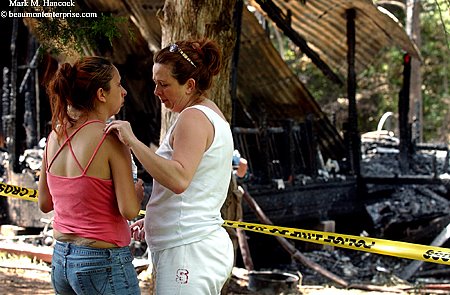
Amanda Collazo (left) is comforted by homeowner Gretta Mitchell (right) following a fatal house fire in Jasper County on Tuesday, July 11, 2006. Collazo's daughter Kyah Collins, 2, and her son Kameron Collins, 3, both died in the fire.

Award winner:   1st Place, News Photo, Press Club of Southeast Texas, Excellence in Media Awards

Award winner:   2nd Place, Spot News, NPPA Region 8 July clip contest


Officials investigate a home following a fatal house fire in Jasper County. Officials said the cause of the fire was yet undetermined, but the family believes a towel over a lamp may have caused the blaze.


Friends and family members watch as officials investigate following a fatal house fire in Jasper County. Five other residents of the home escaped to safety.

Please read "Two toddlers who died in house fire identified" by Jacqueline Lane, Jimmy Galvan and F.A. Krift.
 

A daughter, a son


Mark M. Hancock / © The Beaumont Enterprise

Amanda Collazo (left) is comforted by homeowner Gretta Mitchell (right) following a fatal house fire in Jasper County on Tuesday, July 11, 2006. Collazo's daughter Kyah Collins, 2, and her son Kameron Collins, 3, both died in the fire.

Award winner:   1st Place, News Photo, Press Club of Southeast Texas, Excellence in Media Awards

Award winner:   2nd Place, Spot News, NPPA Region 8 July clip contest

Please see the entire package.
 

Stupid like a Fox

Y'all know how I react to attempts to control freedom of the press. Now, the Fox network (owned by News Corp) has decided to challenge AP and specifically press PJs. The Washington Post reports:
The Associated Press is protesting plans by Fox to bar photographers from its news conferences at the Television Critics Association press tour and says it will not cover the events unless the network changes the policy.

Read more...
Bravo AP. Thanks to Justin for pointing out this conflict.

Personally, I haven't ever seriously watched Fox television. This latest ploy is simply one more reason to avoid anything related to Fox.

Now, if AP really wants to make a point, it should see how many Television Critics Association members it can talk into abstaining from the tour (since they are print and online journalists). Another nice move would be to refuse to report on anything Fox - except the slander suits of course.

For working press PJs who want to show their solidarity with AP, all that's required is three little words in the Special Instructions section of the next image you transmit:   "News Corp OUT."

Enough for now,

UPDATE: According to Photo District News, AP and Fox TV Reach Photo Coverage Agreement.

Wednesday, July 12, 2006

Honoring a hero


Photos by Mark M. Hancock / © The Beaumont Enterprise

Linda Breaux gets a hug from a supporter before the memorial service for her son, Marine Staff Sgt. Benjamin D. Williams, at North Orange Baptist Church in Orange on Saturday, July 8, 2006. The LC-M High School graduate and star athlete was killed by an improvised explosive device in Al Anbar province in Iraq on June 20, 2006.

Award winner:   3rd Place, News Photo, Texas Press Association, 2007 Better Newspaper Contest.


Linda Breaux gets a hug from a supporter before the memorial service for her son, Marine Staff Sgt. Benjamin D. Williams, at North Orange Baptist Church in Orange.


A Marine honor guard departs after posting the colors during the memorial service for Marine Staff Sgt. Benjamin D. Williams at North Orange Baptist Church in Orange.


Please read "Orange Marine memorialized by high school" by Dee Dixon to learn more about Staff Sgt. Benjamin Dewayne Williams.
 

Williams memorial


Mark M. Hancock / © The Beaumont Enterprise

Linda Breaux gets a hug from a supporter before the memorial service for her son, Marine Staff Sgt. Benjamin D. Williams, at North Orange Baptist Church in Orange on Saturday, July 8, 2006. The LC-M High School graduate and star athlete was killed by an improvised explosive device in Al Anbar province in Iraq on June 20, 2006.

Award winner:   3rd Place, News Photo, Texas Press Association, 2007 Better Newspaper Contest.
 

Tuesday, July 11, 2006

Casey Templeton interview - Part B

Please read Casey's bio, Part-A of this interview and see his images.


Courtesy photo / © Casey Templeton

How do you view yourself professionally?
I'm a rookie. Big time - just like in everything. I'm down at the bottom of the totem pole now. I completely understand I can't clutch on one award for the rest of my life. I can't always rely on that to open doors for me. I have to understand I'm a small fish in a very big pond now.

So, I have to look at myself as a professional who's still learning. I always want to seek advice. I'm also very unsure about the direction I'm going to go as a professional photographer.

I still want to wait and see how Geographic goes and, hopefully, I'll have a chance to show my style to them and prove to them that I can work with them. I think a lot of questions are going to be answered after my internship's over with Geographic. Right now, I'm in an in-between stage.

I'm never going to go portraiture work. I'm always going to be photojournalism.

I just want to go where my heart leads me to go with my photography. I know I want to do photojournalism, but I've just got to figure out in what outlet I want to pursue it. Whether it be newspaper or magazine or a mixture. I really don't know yet.
The image you made earlier this month for The Washington Times of journalist Peter Wallsten has had a lot of play. Please talk about the image.
For any young photographer, walking through the gates into the White House is a whole other ballgame. Everything you've learned in the past just becomes a blur. You're just thinking to yourself, "How in the world am I going to shoot with these White House photographers? How in the world am I going to be able to do anything that can mount up to the kind of work that they're doing?"

I was very intimidated because it was my first time being at the White House, first time being around the President, first time being in a high-security area like that. I told myself early, I said, "You know what, I have to overcome this. I have to understand that I deserve to be here, and that I've earned a right to be here."

I went to watch and learn from the other photographers. But I also wanted to create a different image from everybody else.

President Bush was to give a press conference that day. So, Mary Calvert was the photographer I was helping out that day. She told me to go to the back, try to find a place in the middle for when the President comes out. Just find yourself there.

I was there at first when he came out, and then I noticed there's 30 or 40 photographers in this one area, and they're all getting the same shot. I said, "There's no way I'm going to get a better photograph than any of these guys." So I said, "How can I separate myself?"

I found a spot where nobody else was standing. I went as far back behind as I could - as far as the Secret Service guy would let me - and I just said to myself, "I'm going to be back here in case something happens, I'll be the only photographer that has it."

I kept shooting. I just shot everything that was happening. In that time, I took a photo of President Bush speaking to the LA Times reporter. I just kept going with it, but I knew that if anything were to come up during that day, I'd have a different perspective than the other 30 photographers that were there.

Later that day, we found out that Bush had, kind of, poked fun at a reporter that was legally blind and I said, "Let me look through my shoot and see if I have anything." I did. The Washington Times ran it. It ended up catching on and got onto AP and ended up in several different places.

The basic gist of that is separate yourself. If you see 30 photographers standing in one spot, be somewhere else. I tried to do that, and it paid off.
Was it a ride-along?

Kind of. I was just doing a week-long internship with The Washington Times. I was there only for the week and that particular day I was to be at the White House. I was meeting The Washington Times photographer, Mary Calvert, so it worked out great.
How did you prepare?

First of all, I assume you have to have a purpose for being at the White House. So, the director of photography at The Washington Times called in and got me cleared to be at the White House that day.

I had to give my Social Security number, my birth date, and then you had to be screened and moved along with all the other photographers.

[It's important to have a] very clean record. You always have to think about history before you think, "I'm a college kid. I can do whatever I want to do, and it doesn't really matter." You do have to have a clean record. You have to keep your nose clean.
How dressed?
I dressed up. I had nice pants, nice shoes, nice shirt, nice tie. I wanted to be very presentable - very businesslike. You have to approach it just like a business meeting. You can't wear shorts and a T-shirt like you would shooting a Washington Nationals game.

You have to plan ahead and present yourself professionally.
What does it take to be successful in this profession?
That's a good question that I wish I knew. I don't have the answer to that yet of course. But, I think you have to be a very hard worker. You have always be willing to learn. You have to take sacrifices.

One thing that I'm noticing is that you really have to respect yourself, and photography and other photographers. You have to respect your images. You have to respect the copyrights of your images. You don't want to sell yourself short. A lot of photographers are doing that and it's hurting the business.

Young photographers constantly need to know that it's not going to be easy for you to be successful. No one's going to pave the way for you to be a successful photographer. There's a lot of competition. There's 10,000 other photographers just like us that are working twice as hard as we are. We have to go out there with that mentality.

[Ask yourself,] "How can I make a difference? How can I be different from everybody else?"

If you can offer something that nobody else can, you're going to be successful as long as you don't get a big head, as long as you don't think that you're better than other people. Again, you always have to be a fan of other people's work. You have to be a fan of other people.

Never get ahead of yourself. Never treat people with disrespect.
What have you discovered about the profession that you did not expect?
I haven't been in it long enough to really find out things, but I am noticing just the amount of people that are out shooting the very same thing that you are and how extremely difficult it is to get your images out there and to be seen. I'm just noticing the extent of the competition that's out there, and how many other people are standing in line to take your job if you're not willing to work at a particular level. If you're not willing to put in the extra hours.

You always have to be on your toes. I'm learning that it's a tough business, but longevity and having the mentality of knowing that it’s a marathon and not a sprint. You just got to keep that in mind and never get discouraged.

Don't get discouraged when things don't go your way or you've had a slow month or that other people are out there doing work that you think is so much better than yours. Don't get discouraged by it.
What's the future of news photography?
Sadly to say, I see newspaper photographers coming at a very big disadvantage. At many newspapers, including like The Dallas Morning News, they're pulling still frames from video and they're using them in the paper. That's not necessarily a bad thing because a lot of the staff photographers are learning video and are out there shooting it.

I think that storytelling is very important and I think it's great for the Web, but people that have cell phones are producing images that are print-quality for newspapers. People that drive by an accident, like in the London bombing, most of the photos we saw from that were from cell phones. They ran on the front pages of every newspaper in the world.

Where were the photographers then? They weren't necessarily there, so they got beat out.

I see more and more downsizing at newspapers. More and more newspapers [are] running images from cell phones and still images from TV. I think a lot of newspaper photographers - just from me being a new person in the business - I can see it's not a great position to be in. There's a lot of nervous newspaper photographers out there as well as magazine photographers.

I'm sure I'm just preaching to the choir, but there's a lot of changes that are going to be made. You have to prepare yourself for it. You have to constantly be willing to learn new things just to be able to survive.

Flexibility is important.

I graduated college without a degree in photography, but I learned Web site design. I learned multi-media. I learned to shoot and edit digital video. I learned how to put all of this on the Web and to design it.

I understood that I couldn't just rely on my eye and photography. I had to be able to present myself as being very well rounded as a journalist, not just a photojournalist.

You have to look at the newspaper as a business. If the business isn't doing too well, you got to cut your risks. You can't blame anybody for doing it. There's huge changes going on.

The information that's being presented is online and through wires and things. Sometimes it doesn't make sense to send a reporter or send a photographer. You can just save money and have the story that somebody has already sent somebody there to do it.

I don't really know much about it, but I can see newspaper business is a scary place to be right now. I think you're going to see a lot of newspaper photographers stepping out of the business and going to work for themselves. They're starting to have more respect for their images and more respect for their time as a photographer. They're trying to get more respect.

I think that's a good change for individuals.
Someone must acquire images for the wire. Is it important to shoot overseas?
It's extremely important. Not just as a photographer, but in general - in living. You have to get out of this country just to see how the rest of the world is living.

Once you leave this country for any amount of time, you'll come back, and you'll appreciate it so much more. For a young photographer and a young college student to be able to travel across the world is going to help you not only in your photography, but also in your education as a young citizen.

It's very important for these photographers to get out there and go across the world.

Everybody - including every college student and young photographer - should leave the country and try to find stories. They're going to leave, and they're going to appreciate more the U.S.

It's just very important for people to travel. But, one big thing to understand about that is never get discouraged if you cannot leave the country.

With me, I saw people from previous competitions and CPOY that had gone to India or had gone to Africa or gone all over the world. I thought to myself, "Man, I'm not going to be able to win this competition unless I leave the country and find some exotic story to work on."

Then I realized, I won't be able to leave. So I had to make provocative images around where I am. That was a new challenge to look at your local county or your local state as being somewhere exotic. Look at it as a possibility for images.

In my portfolio for CPOY, they were all done in Virginia, except one or two were from up north somewhere.

Never feel like you have to travel to make great images. Make it happen around where you are.
How important is it to be technically proficient?
Very. With digital photography, you can never loose track of your technical skills. A lot of times people are shooting in RAW because they say, "I can fix it in post."

You have to be able to nail it. You have to be able to understand your camera. You have to be able to understand your settings. You have to be proficient in your post-production work. That's something I'm always struggling with is my editing.

With your camera, your technical skills are priceless. When you can use your style and find your style of shooting, but also have great technical skills that's when you're really starting to make things happen.
How important is it to be proficient with flash or studio lighting?
It's very important because you can't always expect to have great lighting wherever you go. So you have to be able to create great lighting. Using your flash and doing great studio work on location is priceless. It's something that will help pay the bills in the future.

With me, my lighting is very different. I shoot with a very minimal amount of equipment. I just use two Canon 550s. If you can make things happen with that on location, and you can travel lightly, then it's going to help you in the long run.

With the MACRoCK images, I wanted to use a very high aperture and fast shutter speed and use my flash zoomed in as far as it could go to make some different, dramatic effects.

There's not much editing there. If you can nail it in your camera, it's going to help you in your post.
How did you learn it since you didn't have extensive photo classes?
I learned it from playing around. Taking pictures of my family and my friends. With these digital cameras, it's a huge help to be able to learn your flash work because you can try something and see how it looks automatically on your camera.

I did a lot of playing around. I took a lot of pictures of my family and set out to try to do something I hadn't seen other people do.

I just learned it by playing around and taking bad photos. After enough bad photographs, you're going to start catching on.
How's the job market look for you and your peer group in general?
I think a lot of young photographers like myself are going to have to start realizing that they have to start looking at shooting more weddings or shooting more things that aren't editorial. You're going to have to start branching out.

You can't expect to live off assignments for Newsweek or Time or Life. You have to think realistically. You have to start being open for different outlets to do your photojournalism.

For young photographers and peers of mine, I think we all have to start being more open to shooting more weddings and shooting more non-editorial work to make a living. You have to be very broad. You have to be skilled in a lot of different areas.

Sometimes with shooting weddings, a lot of people frown on it, but these days, you're still doing photojournalism. You're still creating stories. You're still finding moments. There's no shame in that.

Every wedding I go to, I get better with my lighting. I get better with my camera. I learn more technical skills and practice them. There's no shame in doing what you love to do and actually getting paid the money you deserve to make.

I think that's going to be some of the new changes in people my age and people who want to start respecting the value of their work.
Anything to add?
One thing to add is I love to help people out. I love to learn from other people. I love to answer questions. I love to see other people's work. I can make a promise that anybody that contacts me with questions or contacts me with their work, I will be overly happy to answer them and to keep in touch with them.

I just love hearing from other photographers and other people. I encourage everybody to e-mail me or call me because I want to hear from everybody.
Is this because of your university's lack of a photography program?
Absolutely, that's exactly why. [At JMU], I had to do the same thing. I had to e-mail editors. I had to e-mail other photographers. That's why I try to open up as much as I can to other people.

That's what helped me learn. That's what helped me get to where I am. I just love hearing from other people.
Enough for now,

Monday, July 10, 2006

Casey Templeton interview - Part A

Please read Casey's bio and see his images.


Courtesy photo / © Casey Templeton

Daniel Berman, a high school student in Seattle, asks,
"What is the biggest piece of advice you would give to an 18 year old planning on pursuing a career in photojournalism?"

The biggest piece of advice I can give to a high school student or anybody just getting started is to pay attention to style and be a fan of other people's work. Study their work. Study how they approach things, but never try to emulate another photographer. Always try to take from other people's work what you can see as being positive - what you see as being moving. Then, try to put that into your work and try to add your own style to it.

If you have your own style, it'll take you a lot further than just getting the safe shots. A lot of photographers have portfolios they put together, and it consists of work that other people expect to see. You've got your spot news, you've got your sports, you've got your feature, and people spend their time shooting to fill that cookie-cutter portfolio. What they need to do is know that the best thing they can do as a photographer is put their style into their work.

The judges noted your style. What are key elements of your style?
I pay a lot of attention to color. I really like difficult lighting situations. So, I like to walk into a difficult lighting situation and make something happen with it. If you walk into something like a fireworks display or something like that, there's going to be great colors. If you do a picture that has great colors of a fireworks display, then you've done a mediocre shot that anybody could get.

But, if you walk into a dark room and the lighting is constantly changing. If you walk into it and say, "Oh no! I have to shoot in here? How do you expect me to shoot in here?"

If you walk into that situation and you find something creative and you make something out of nothing, then you've done something. Your style's shown through.

My style deals a lot with color and emotion. I tend to have a lot of faith-based aspects in my work, and I don't really notice it until afterward. But, that's a big part of everything that I do - my faith is. So it happens to show through in some of the different situations and the different people I talk with. That's usually things I pull from them.

How do your religious beliefs factor into your shooting style?
My faith is important to me, but I'd never try to hold anybody else to it. Somehow the spiritual aspect of different people, sometimes it shows through in my photos. It happens without me really knowing it.

But I'm open to everything for everybody.

What advice do you have about eating Sponge Bob Squarepants pops?
(Laughs) I would recommend in moderation. Yeah, in moderation. How about that. (laughs)

What other advice do you have for young photojournalists?
My best advice to young photographers - like myself, I'm just getting started - is to always be true to your style, be a fan of other people's work. Never get discouraged when you see other people do great work. Never discourage other people. Always be happy for other people when they're putting out great work.

It's easy for a young photographer to see somebody create these stunning images and for you just to have this automatic competition with them. It's an automatic thing that makes you really hate the fact that they're doing great work. That's part of competition. That's part of you always want to improve.

But I would always recommend that you should never be discouraged by other people doing great work. Always be encouraged by it and always look at it as a resource for encouragement. But that's challenging.

That's challenging to me all the time. I see people putting out fantastic work, and I think to myself, "Jeez, why am I not doing that kind of work? Why am I not doing that level of work?" But, you never want to discourage yourself about it.

Another thing for young photographers is to always seek advice from other people. Always ask questions, always have people look at your work and never be discouraged by bad photos. The best way to improve, I think, is to challenge yourself to take bad photos. Those are the photos that you're going to learn from.

Go out and you try something new. If it doesn't work out, look them over [and] see what you can do differently the next time.

I learned on 35mm film. Now, most of the people getting started are learning on digital. The advantage I see to learning on film is that you didn't have that instant gratification. I would shoot a roll of film a week or so. My mom would go to work and have it developed.

I remember waiting at the top of the steps for her to get home with my photos. The majority of the time I'd have a roll of 24 photos and, maybe, two of them came back OK. That would me you had 22 photos that turned out awful.

But, how you have to look at it is you have 22 photos that you can learn from. I never paid too much attention to the good photos. I spent most of my time looking over the bad ones. I thought to myself, "How can I improve? How can I do something different here?"

You have to be willing to do something different. Sometimes that's not going to work out, but you have to be willing to learn from it.

How did you start in photography?
In high school, I got a used 35mm camera. Someone in my family had an older camera. I picked it up and started using it. I was also working for the high school yearbook. I was able to work for them and send off rolls of film every week.

Getting started, I would shoot a roll of film. My mom would take it to work. She worked at Kroger. She would have the film developed and bring it home in the next few days. I'd have the photos, look through them and learn something. The next time I went out, I'd always keep that in mind.

I was looking at prints. I never did much film processing. I never did any darkroom work.

Then, I started working for this company called Life Touch, I did sports photography for them. I went to different high schools and shot their team sports - action sports. That was a tragedy at first, but it turned out OK. I was learning to shoot sports while shooting film, so it was difficult.

How did you choose James Madison University?
I didn't have the choice of going out of state. I had to pick a university in state. JMU happened to be the school I felt most comfortable with.

I knew I wanted to do something with photography, but I knew there wasn't a photography program there. So what I decided to do was find something that could help me in everything but photography. Other areas that are important in photography, but a lot of people don't think about.

Four years ago, I'd really love to learn how to make a Web site. I'd really like to learn how to do some multi-media. I'd really like to work on my caption writing. So I did feature writing, news writing. I'd really like to learn some media history. So, I did everything but photography.

JMU felt comfortable. It felt great. I felt at home there. I'm so glad I went.

JMU doesn't have photography program?
They have one class in photojournalism. It's an eight-week course. I took that my sophomore year. It was great because my mentor, Tommy Thompson, taught the class. That was the one photography class I took.

They also have an art department at JMU. They have several photo classes with that, but my senior year I took an independent study with an art photography class. We didn't shoot necessarily, we didn't learn much about photography. We did our own projects and talked about them in the class.

So, no, there's no photojournalism program. There's not really a photo program. I just did everything but photography in college.

Do you think you would have done as well at a "photojournalism" university?
I don't think I would have. I think coming to a school where there wasn't a photojournalism program really made me become more self-motivated. I had to go out and make stories. I had to go out and just have my camera and look for different photos. It's a whole new challenge when you're shooting for yourself and not shooting for a class or for somebody else. That's a big challenge to go out and find stories.

Since I didn't have a photojournalism program, I developed more of a style that's a little bit different than everybody else because I had no prior education. I had no structure in the way that I was learning.

I just trusted my eye and did work that felt natural to me. Again, I clutched on my style and things worked out well. I don't think I would have done as well being around several other photographers all the time. I think I could have sacrificed my style just to make a better grade on an assignment.

So the answer is no I don't think I would have done as well if I went to a photojournalism school.

What do you wish you had learned in college?
I wish I would have learned more of the business side of photography. Not necessarily accounting and financing, things like that. I wish I had learned more about running your own business. I wish I would have learned more about stock photography or commercial photography, just everything.

So many kids my age are coming out of school and we've learned so much about photography, but we know nothing about the business of photography. That can really hurt us.

What specifically?
When you come out of college, what's your day rate if you're going to do an assignment for somebody? How much taxes do you think you should take out? How do you plan to live off the money you make in photography?

This summer I'm going to be helping out with a lot of the studio photographers and a lot of commercial photographers because I want to learn how they run their business. I can apply [the knowledge] to my future career in photojournalism.

If you're a good photographer and a good businessman it's going to take you a lot further than just being a great photographer.

Basically, I'm going to be seeking out advice from photography business owners. I just want to be there. I'm doing other work this summer to make my money to where I can spend the week [learning].

I would like to do some paid assisting, but if I don't get paid, that's OK. I just want to be there. I just want to learn how everything works. Hanging out and learning. I'll always be learning. I have a lot more learning to do, especially on the business side of everything.

Is it good or bad to take internships?
I think it's fantastic to do internships. That's learning that you can't get in the classroom.

I think it's absolutely priceless to work, especially to start off at a small newspaper so you can see how many roles - how many hats you can wear as a photographer - at a small newspaper.

Most students come out and they will start working for a small newspaper and they got to understand you will be reporting, you will be photographing, you will be responsible for good captions. You will be responsible for shooting three, four, sometimes five assignments per day. You have to learn the workflow and time management. It will also help you appreciate when you start working for bigger newspapers and bigger magazines.

How important is competition in the industry?
Competition can go either way. Sometimes you can get addicted to competition and you can shoot strictly for competition. That can be detrimental. But, competition can be a great way of learning.

When you see a competition and the final results and you see what's winning competitions, you start to see the images that are different - the images that straight away from all the other ones - are usually the ones that rise to the top. That's a great learning tool to teach you what you need to be looking for when you're at an assignment.

Competitions are also good because you see how you're comparing to your peers. You also see what you need to work on.

For instance, with College Photographer of the Year, this past year's competition, I'm very blessed to have won it. But, I also am smart enough to know it could have gone either way.

If there were any three different judges there, the entire competition could have swayed a whole other way, and I could have not even placed. You have to understand that, especially when you lose in competitions you have to understand that. It's just those judges on that day. If it were any other day or any other judges, things could have gone completely different. So never put your own work down because of that.

You went to Missouri the year before you won. What did you learn by watching the judging process?

When I went out to Missouri to watch the judging of the competition the year before, I was able to listen in on the judges. I was able to listen to what they said. What they didn't like. What they did like. I was just able to learn about different people's styles. I was able to learn how aggressive you need to be with cropping images, how you need to be about toning images, how important it is to find that decisive moment.

On a side note, I also learned that judges - for some reason - love black and white images.

One great piece of advice I got a few years ago is before you enter a competition, you need to research it. You need to research the judges. You need to research previous winners. You need to research what's been winning the past few years.

That's a big challenge to young photographers. Sometimes they don't know what to enter or they don't know how much to enter. A huge thing is your edit. I learned when I went out there editing down your work is very important. Although you can be very attached to a particular image or a set of images, you have to take an outside viewpoint of it and find your strongest work.

With CPOY, I realized that you want to have the minimal amount of singles, which is eight. If you look at the past three winners - including myself - there are between eight and 10 single images and then two stories - very tightly edited.

That's something I noticed and that's something I kept in mind when I entered the portfolio. Some of the people that entered the portfolio competition this past year had three or four stories. If they had narrowed that down and had a tight edit, I think that they definitely would have taken the competition.

But, if you have way too many images in your portfolio, the cream of the crop of your work won't be seen.

Some of the people in the POYi portfolios, they enter four or five stories and it wins. But, in college stuff, a lot of times, you don't have the access like some of these professionals do. You don't want to have a story about an ice cream man, a story about a kid with cancer, a story about a high school teacher. You don't want to have all that stuff. You just want to have your best work. Every competition is different. You just have to know the competition before you enter it.

Enough for now,

Please see Part B of this interview.
 

Sunday, July 09, 2006

Beaumont fireworks


Mark M. Hancock / © The Beaumont Enterprise
Fireworks burst near the Tyrrell Historical Library in downtown Beaumont on Saturday, July 8, 2006. Tuesday's scheduled fireworks display was postponed due to weather.

Jeremy Lock:   Military Photographer of the Year

Jeremy Lock was born in Almagordo, N.M. on 19 Dec. 1970. He is currently a U.S. Air Force combat photojournalist stationed at Charleston Air Force Base, S.C. with the 1st Combat Camera Squadron and currently serving in Iraq. He is a two-time Military Photographer of the Year winner (2005 and 2002).

Lock has worked around the world with the military. His work has been published in Time and other national magazines as well as major newspapers across the United States including The New York Times, The LA Times and The Washington Times. His work has also been published in books including "The War in Iraq" and "A Day in the Life of the Military."

He also freelances for PBS. His latest work was a documentary titled "Slavery and the Making of America."

In addition to his winning portfolio, additional images can be seen at jeremylockphotojournalist.com.

Lock resides in Charleston, S.C., is single and has two sons Keatin, 10, and Koen, 8. He is working toward a bachelors degree in photojournalism from Syracuse University.

Please read Jeremy's interview.

Enough for now,

Ask a question:   Jeremy Lock

Ever wanted advice from two-time award-winning military photojournalist? Well, here's your chance. Jeremy Lock has agreed to an interview.

Leave your questions in the comment section or drop me an e-mail. I plan on asking the standard questions, but this is a chance for y'all to ask a specific question and get a specific answer.

Please leave your questions by Saturday, July 8, 2006.

Please also see other interviews with previous award winners David Leeson, Michael Ainsworth and Todd Heisler as well as Rick Gershon and Casey Templeton for example questions.

Enough for now,

Saturday, July 08, 2006

Drillers v. Katy NIFL football


A Katy defender knocks Beaumont's Franklin Paul (No. 23, right) into the stands during a NIFL football game at Ford Arena on Saturday, May 20, 2006.

Mark M. Hancock / © The Beaumont Enterprise

The Drillers host their first playoff game tonight against Katy. In an unusual move, tickets to the game are free.


This cutline isn't typical. The Katy player isn't identified and consequently this shot got killed (it ran on the Web only). Unlike other football photos, the cutline problem isn't with knowing which number is involved in the play (it's obviously No. 21). Instead the problem is with the team's roster, which still hasn't been corrected. I suppose the other option is Jared Dotson had a Michael Jackson treatment.
 

Friday, July 07, 2006

The Rocket returns to Houston


Photos by Mark M. Hancock / © The Beaumont Enterprise
Fans cheer as Astros pitcher Roger Clemens enters the field to pitch against the Minnesota Twins at Minute Maid Park in Houston on Thursday, June 22, 2006. Fans include (front row from left to right) Jenny and Bob Radtae from Kingwood; Carol Garner, wife of Astros' manager Phil Garner; her grandson Gage, 1; her daughter-in-law Tammy Garner and Ray Miller of Houston.


Roger Clemens (No. 22) pitches during the first inning against the Minnesota Twins at Minute Maid Park in Houston. It was his first return game since his announced retirement.

July 2006 iTunes

* (Sittin' On) The Dock of the Bay by Otis Redding
* Contigo en la Distancia by Christina Aguilera
* Europa by David H. Yakobian
* Eye of the Tiger by Survivor
* Fighter by Christina Aguilera
* Hoe-Down from Rodeo by Leonard Bernstein & New York Philharmonic
* I'm Alright by Kenny Loggins
* Low Rider by War
* Si No Te Hubiera Conocido by Christina Aguilera
* Something About You by Level 42

Check out the iTunes samples.

Thursday, July 06, 2006

YMBL winner


Jacob Broussard, 14, of Beaumont watches his shot drop onto the green during the annual YMBL Golf Tournament at Bayou Din Golf Course in Jefferson County on Tuesday, June 27, 2006. Broussard won the 14-15 division with a total score of 143.

Mark M. Hancock / © The Beaumont Enterprise

Yang interviews Hal Buell

Fellow blogger Wayne E. Yang posted a great interview with Hal Buell, former Head of the Associated Press Photography Service.

Enough for now,

Wednesday, July 05, 2006

Newton women


Mark M. Hancock / © The Beaumont Enterprise

Newton County deputy Cynthia Hall (left) and Assistant Criminal District Attorney Misti Weeks Spacek (right) pose for a portrait at the district attorney's office in Newton on Wednesday, June 28, 2006. Both are the first females to occupy their county positions.

Tuesday, July 04, 2006

PAYC sailing class


Photos by Mark M. Hancock / © The Beaumont Enterprise

Students carry a sailboat onto a ramp at Pleasure Island Marina during a sailing class in Port Arthur on Saturday, July 1, 2006.


Bryan Miller, 10, of Orangefield waits to launch a sailboat before a sailing class at Pleasure Island Marina in Port Arthur. The weekend-long class was sponsored by the Port Arthur Yacht Club.


Celeste Harder, 9, of Beaumont (left to right in closest boat), instructor Paul Vera and Colton Phelan, 13, of Beaumont tack to catch up with a sailing class at Pleasure Island Marina in Port Arthur.


Several sailboats maneuver around buoys at Pleasure Island Marina during a sailing class in Port Arthur.

Monday, July 03, 2006

China murders reignite memories


Photos by Mark M. Hancock / © The Beaumont Enterprise
Darline Williams talks about the 1997 murder of her family at her home in Beaumont on Friday, June 30, 2006. Today's murder in China, Texas features many similarities to when Paul Dixon killed Williams' sister Evelyn Williams, her 9-year-old niece Amber Taylor and mother Altre Mae Williams.


Darline Williams holds the obituaries of her family members murdered at her home in 1997 in Beaumont. She said she sleeps with the memorial display to feel closer to her family.

..."That's when they (neighbors) say I took the knife and stabbed him," she told The Enterprise, adding she has no independent recollection of her actions.

Autopsy results reported in The Enterprise said Dixon was stabbed 21 times in the head and neck - all inflicted after the gunshot wound. Wounds on his neck were a half-inch to 2½ inches deep, hitting the left carotid artery and jugular vein. Cuts to the left side of his head penetrated about a fourth of an inch and his skull was chipped in one spot.

Though the stab wounds were potentially fatal, medical examiners ruled the death a suicide resulting from the gunshot wound, The Enterprise reported.

The knife never was found and in 1998, the Beaumont Police Department turned the stabbing case over to the district attorney's office for further action that didn't come.

It remained a story many neighbors and friends knew, but no one really talked about...
Please read "China family slayings stir memory of 1997 domestic nightmare" by Jennifer Avilla.
 

Sunday, July 02, 2006

China murders


Photos by Mark M. Hancock / © The Beaumont Enterprise
Regional Crime Lab investigators remove evidence from the Jennings home after a domestic triple murder and suicide in China, Texas on Friday, June 30, 2006. Richard Jennings killed his wife Leslie Jennings, 7-year-old daughter Carmen Jennings, 11-year-old son Nathan Jennings and self as well as injured Jefferson County deputy Ed Martin with a shotgun around 3:15 a.m. today. Cullen, 13, the family's other son, survived.


China Elementary principal Melanie Nunez (left) and Henderson Middle School principal Mary Alice Jones (right) prepare to counsel the community following the homicides in China, Texas.

Please read "4 die in domestic carnage" by Beth Gallaspy and "Grieving China community wonders why" by F.A. Krift.
 

Saturday, July 01, 2006

Southeast Texan


Darrell Nolen of Beaumont prepares a crab net at Walter Umphrey State Park on Pleasure Island in Port Arthur on Saturday, June 24, 2006.

Mark M. Hancock / © The Beaumont Enterprise

Friday, June 30, 2006

Direct Social Security


Photos by Mark M. Hancock / © The Beaumont Enterprise
John Prejean, 86; (clockwise from top) Sandra Rafter, 71; Ralph Osborn, 92; and Priscilla Burrows, 65, play bridge at The Best Years Senior Center in Beaumont on Friday, June 23, 2006. The Social Security Administration wants seniors to apply for direct deposit.


Sandra Rafter, 71, considers her options during a bridge game at The Best Years Senior Center. Social Security Administration officials said it's critical in hurricane-prone areas to keep seniors from having the same problems as those who were displaced by hurricanes Rita and Katrina.


Seniors play bridge at The Best Years Senior Center in Beaumont on Friday, June 23, 2006. During the mandatory hurricane evacuation period, many seniors needed their Social Security payments while out of town. Even when they returned, mail was not delivered until streets were clear and gasoline was available.

Two copy editors/designers needed HERE

UPDATE: Any reporters at The Dallas Morning News are welcome to apply for an open reporter position. The position has not been posted yet, but The Beaumont Enterprise wants to help the folks facing job cuts at DMN. Only reporters from DMN should direct their resumes and cover letters via e-mail to Managing Editor Brian Pearson.

When applying for any job, mention you saw this opening on this blog (PhotoJournalism). One copy editor/designer position is immediately open. The other position needs to be filled by August 1, 2006.

The Beaumont Enterprise, a 60,000-circulation Hearst daily newspaper in Southeast Texas, is looking for copy editors. Our universal desk needs energetic and experienced copy editors/page designers with one to two years daily newspaper experience that can be a vibrant addition to our fast-paced schedule.

The right candidate should be an excellent wordsmith; have experience with Quark and Photoshop; and work well under a two- to three-edition deadline. Knowledge of Illustrator and/or Freehand a plus, but not required. Also, our copy desk has become an integral part of our online operation, so Web experience is a plus.

The ideal candidate will be versatile, able to handle the front page one night and sports the next. Send resume and up to 10 page clips to Managing Editor Ron Franscell, Beaumont Enterprise, P.O. Box 3071, Beaumont TX 77701, or e-mail to rfranscell@hearstnp.com.

FYI, one copy editor became a news editor at another paper while the other copy editor is returning to university to get a masters of arts. So, congrats to both of them. :-)

The paper provides high-quality content and expects high-quality editing and design. Among other awards, it was named as this year's top newspaper in its division at the Texas Press Association Better Newspaper Contest. Awards from only this contest include:

Sweepstakes Winner (1st)
1st General Excellence
1st News Writing
1st News Photo
1st Headline Writing
1st Feature Story
1st Community Service
2nd Page Design
4th Editorials
4th Sports Coverage

Enough for now,
 

Thursday, June 29, 2006

Neches River redfish


Photos by Mark M. Hancock / © The Beaumont Enterprise
Beaumont resident Leonard Joubert fights a redfish in the Neches River at Colliers Ferry Park in Beaumont on Tuesday, June 20, 2006. Summer officially begins June 21.


Beaumont resident Leonard Joubert nets a 20-inch redfish in the Neches River at Colliers Ferry Park in Beaumont. Recent rains have raised the river's water level this week.

Wednesday, June 28, 2006

Botanical Gardens at Tyrrell Park


A large grasshopper soaks up some sun at Tyrrell Park in Beaumont on Friday, June 23, 2006. Since Hurricane Rita, the park has planned many renovations to ensure its place as a jewel of Beaumont.


Photos by Mark M. Hancock / © The Beaumont Enterprise


Palms and other plants grow at the Warren Loose Conservator & Binks Horticultural Center at Tyrrell Park. Hurricane Rita cost an estimated $300,000 to $400,000 damage to the garden center.


Plants grow in the gardens by the conservator and horticultural center at Tyrrell Park. Although many have donated to the center, including a $25,000 donation from the Magnolia Club, the center could still use some help to get its roots firmly planted.


Please read "Gardens' beauty slowly sprouting after ugly storm" by Jennifer Avilla.

Tuesday, June 27, 2006

Lamar's season ends


Photos by Mark M. Hancock / © The Beaumont Enterprise
Lamar's Erick Kanaby (No. 20) dives safely back to first base during a Southland Conference Baseball Tournament game against Texas State at Lamar University in Beaumont on Wednesday, May 24, 2006.


Lamar's Steve Macfarland (No. 31) pitches during a Southland Conference Baseball Tournament game against Texas State.


Lamar's Dan Hernandez (No. 27, right) gets congratulated by teammates after scoring during a Southland Conference Baseball Tournament game against Texas State.

NPPA Summit recap

Mindy McAdams at Teaching Online Journalism attended the NPPA summit, which featured Richard Hernandez of the San Jose Mercury News. She posted her take on how San Jose PJs are adapting to video.

Enough for now,

Monday, June 26, 2006

Super Gold golfer


Little Cypress-Mauriceville High School's Ryan Prejean poses for a portrait at Sunset Grove Country Club in Orange on Wednesday, June 7, 2006. He was named as The Beaumont Enterprise boys player of the year on the Super Gold Golf Team.


Mark M. Hancock / © The Beaumont Enterprise

He hadn't signed to a college when I shot this. However, he said he'd like to go to UT if he could get a scholarship. ;-)