Showing posts with label editorial. Show all posts
Showing posts with label editorial. Show all posts
Monday, December 31, 2018
Quick Tips to Improve Photos Video
video, narration, beats by Mark M. Hancock / © DFWmark.com
photos by Mark M. Hancock / © DFWmark.com, The Beaumont Enterprise and/or The Dallas Morning News
Please watch and share “Quick Tips to Improve Photos.”
The companion "cheat sheet" on this blog is located here: quick-tips-to-improve-your-photos.
This version is visual hot sauce to some. There is a slower version to savor each frame. It's located at "Savory Tips to Improve Photos."
Please share and subscribe to the NewsEagles YouTube channel (it’s free and easy). Please follow this link, sign in to YouTube (or create an account) and hit SUBSCRIBE at www.youtube.com/newseagles
Although I will do some additional work in the future, this is my Magnum Opus.
Enough for now,


Thursday, March 22, 2018
Mardi Gras World Tour
photos and soundstripe by Mark M. Hancock / © DFWmark.com
Artisans work while tourists are guided through the Mardi Gras World fabrication areas and float den in New Orleans on April 13, 2015. The facility prepares and manages more than 500 floats. Artists work all year, and tours are available every day except Christmas, Thanksgiving, Easter and Mardi Gras Day (Fat Tuesday).
Please share and subscribe to the NewsEagles YouTube channel (it’s free and easy). Please follow this link, sign in to YouTube (or create an account) and hit SUBSCRIBE at www.youtube.com/newseagles
Enough for now,
Friday, February 16, 2018
Savory Tips to Improve Photos
video, narration, beats by Mark M. Hancock / © DFWmark.com
photos by Mark M. Hancock / © DFWmark.com, The Beaumont Enterprise and/or The Dallas Morning News
Please watch and share.
This is the long form of this video. It allows viewers more time to savor each image. For a spicier version of this same presentation, please see "Quick Tips to Improve Photos." It is only about 14 minutes long. Don't blink.
The companion "cheat sheet" on this blog is located here: quick-tips-to-improve-your-photos.
Please share and subscribe to the NewsEagles YouTube channel (it’s free and easy). Please follow this link, sign in to YouTube (or create an account) and hit SUBSCRIBE at www.youtube.com/newseagles
Although I will do some additional work in the future, this is my Magnum Opus.
Enough for now,
Saturday, February 03, 2018
Know Your Rights as a Citizen Photojournalist
video, narration, beats by Mark M. Hancock / © DFWmark.com
photos by Mark M. Hancock / © DFWmark.com, The Beaumont Enterprise and/or The Dallas Morning News
Do you know your rights as a photojournalist?
Please watch “Know Your Rights as a Citizen Photojournalist.”
Please share and subscribe to the NewsEagles YouTube channel (it’s free and easy). Please follow this link, sign in to YouTube (or create an account) and hit SUBSCRIBE at www.youtube.com/newseagles
Enough for now,
photos by Mark M. Hancock / © DFWmark.com, The Beaumont Enterprise and/or The Dallas Morning News
Do you know your rights as a photojournalist?
Please watch “Know Your Rights as a Citizen Photojournalist.”
Please share and subscribe to the NewsEagles YouTube channel (it’s free and easy). Please follow this link, sign in to YouTube (or create an account) and hit SUBSCRIBE at www.youtube.com/newseagles
Enough for now,
Saturday, January 20, 2018
What is a Photojournalist? (short video version)
video by Mark M. Hancock / © DFWmark.com
Have you ever wondered about the why, how or what of being a photojournalist?
Please watch “What is a Photojournalist?” – the shortened version.
Also, if you’re not a subscriber please subscribe to my YouTube channel (it’s free and easy). Please follow this link, sign in to YouTube (or create an account) and hit SUBSCRIBE at www.youtube.com/newseagles
Enough for now,
Have you ever wondered about the why, how or what of being a photojournalist?
Please watch “What is a Photojournalist?” – the shortened version.
Also, if you’re not a subscriber please subscribe to my YouTube channel (it’s free and easy). Please follow this link, sign in to YouTube (or create an account) and hit SUBSCRIBE at www.youtube.com/newseagles
Enough for now,
Thursday, September 25, 2008
Create B2B vouchers instead of bailout
Here's a program to help fix the overall economy and get us back on track. The system sounds complicated, but we already understand the principles. It merely needs to be defined into concepts we already understand.
Explanation
Each month, we all get "paid." If you're like most Americans, you actually receive computer credits through electronic funds transfer (EFT). It equates to actual cash. However, it appears in your bank rather than in your pocket as greenbacks. These electronic funds are guaranteed by the government.
We pay all our bills, go to the movies, get our coffee and perform every other function of our lives without ever touching an actual piece of cash.
At the end of the month, we've probably carried only 20 bucks in actual cash. The rest of our income and expenses were handled electronically through debit cards or checks. Everyone got their proper amount of electronic money while we earned our electronic money for the following month.
This is everyday life unless you're a strange person, who insists be being paid in gold.
Skepticism
I've heard the dire warnings issued by proven liars and people who put us all into this mess in the first place. Consequently, I'm not inclined to believe them.
When I hear there is only ONE way to fix this and it involves NO oversight, I put on the brakes. This is more "Shock Doctrine" being pushed by an exiting lame-duck president to make the greedy richer.
A fair way to spur the economy
I was talking with my brother earlier this summer. The conversation turned to tax write-offs. He said he liked the option of tax write-offs, but wished they were immediate. So does everyone in business.
I've considered how this could be possible (everything is possible if there's enough will behind it). I imagine this is something any respectable politician could grab and turn to everyone's benefit.
Basic concept
The basic concept is simple. Implementing it is slightly more difficult. However, if we look at both the short-term and long-term benefits, it's logical and fair.
The goal is to allow businesses to benefit from an immediate tax write-off upon purchase. A legitimate, tax-paying, U.S. business would essentially get to purchase business-related products and services interest-free against potential profit.
It's a legal system of barter and credit all rolled into one. The businesses benefit, the employees benefit and the government benefits.
Benefits
The immediate benefit is an actual business and industry shopping spree and redevelopment. It also makes "Made in America" the single most valuable tag on any product without being protectionists.
Businesses will immediately be motivated to:
1) Purchase US-made products and services
2) Hire more employees to fulfill these orders
3) Aggressively advertise these products and services in various media
4) Invest in core business products to improve efficiency, ecology and performance
5) Repatriate corporations that have moved offshore for tax purposes
6) Make marginal companies report taxes accurately and pay their fair share
Negative aspects
With any governmental program designed to move a country's economy, there's must be some bureaucracy, but it won't cost $700 billion. Additionally, some companies won't be able to directly benefit from this program for various reasons.
From a business-owner's point of view, it forces businesses to make a profit (not an entirely bad thing).
Some will say this is spending tax dollars. However, it's tax dollars that wouldn't be paid anyway (they're legitimate write offs). It only means the money must be repaid instead of written off.
When you consider the Wall Street bailout, this is a more logical alternative because this plan involves real jobs, businesses, money and products. There's none of the fictitious stuff and no way for corrupt executive abuse of the system.
Carrots
The big carrot in this plan is every U.S. business can immediately purchase U.S., business-related products and services at no out-of-pocket cost. The secondary carrot is the uncorking of business-to-business (B2B) activity.
Sticks
Only tax-filing U.S. businesses can participate. Furthermore, those with a proven profit capability or significant prior year write-offs will be the first beneficiaries.
If a company doesn't file U.S. taxes annually or "cooks the books," the company is only hurting itself.
The biggest, baddest stick is the IRS is actually holding the note. The IRS has the absolute power to eliminate businesses and garnish wages. They can impose painful penalties and interest is compounded daily if payments aren't made when due. This alone makes this profitable for taxpayers.
How write offs work now
Currently, a business must have capital available to pay for a hypothetical widget. This expense is removed from the company's operating budget. The company uses the widget to earn cost plus profit (as a raw material or resale).
The cost of the widget (as well as various other business expenses) is written off against the gross profit (income). Additionally, all other business expenses are written off against gross profit to establish net profit. Taxes are then paid on the remaining net profit.
How this program could work
A business gets credits for the last business cycle's raw material expenses, amortized items and profit. This is the working expense budget for products and services (supplies).
Instead of paying cash, the company would fill out a one-page form (a purchase order) or use something similar to a governmental credit card to buy goods and services and file it electronically through the IRS for the vendor.
Instead of the check coming from the company, the government would verify the payer has tax credit funds available and electronically transfer these funds to the vendor for the supplies. These funds would be applied against the tax account of the business that filed the purchase order.
No actual cash changed hands. The business that needed supplies got the supplies with tax credits, but has the burden of filing the proper purchase order. The company with the supplies electronically receives credits from the government and releases the products and/or services.
The seller now has credits to buy from elsewhere. So far, the government hasn't actually paid anything outside a bank and both companies benefit. This is the point where the IRS issues an interest-free digital draft (loan) to the bank to cover the funds.
If this company needs cash (to pay employees, rent or other non-covered issues), they can withdraw the money electronically or as cash.
The company filing the PO then covers costs and makes a profit from the supplies. From this profit, they should set aside the cost of the PO to reimburse the government for the loan (because the PO purchase isn't a tax write off). Then, they must pay other operating expenses. The remaining profit belongs to the company and/or shareholders.
Now, both companies have benefited, the government will be reimbursed with the next tax cycle and the company made a profit.
Additionally, at least one employee kept a job at each of the companies. This creates two employees paying state and/or national income taxes rather than drawing from unemployment. There's also a fraction of a job at the IRS and banks for this transaction.
While the government may not control the capital, the short-term loan should more than pay for itself in jobs saved (income taxes paid) and gross domestic product increases.
Minutia
Any business (including sole proprietors) that filed a U.S. tax form last year is eligible to participate in this program. The U.S. government must set aside start-up funds for the program (these will be reimbursed when the companies file taxes).
These businesses could use last year's expenses and profit voucher credits to purchase raw materials, office supplies, new equipment and services (including advertising). It's essentially a short-term, interest-free loan from the government against the next tax return. This allows the company to immediately purchase goods and services based on prior performance rather than the liquidity of for-profit loaning institutions.
It doesn't mean it's a handout since the true amount of the purchase is paid by the government via the voucher system and this must be accounted on each business' taxes.
It does mean, however, a business must earn an amount equal to or greater than the funds spent during the same time.
While this may sound like a stretch, it means the company can supply products and services to other businesses at full price and accept the voucher PO payments. So, it should balance out.
The only potential problems would be encountered if a business pays its executives/employees too much, pays too much rent or prices its goods and services too low to break even.
Who can't participate
Since only U.S. tax-paying businesses can participate, businesses operating in foreign countries and "under the radar" can't. This would include businesses that don't pay taxes, aren't legal businesses as well as those that owe back taxes.
Bureaucracy involvement
To keep bureaucracy to a minimum, most of this must be accomplished through the IRS and its database. It already has all the information needed and the means to electronically transfer funds.
So, new personnel must be hired by the IRS to manage this program. Hopefully it'll only require a single office of a few computer gurus.
This office's sole purpose is to process online payment vouchers and electronically transfer funds to the companies.
The initial allowance is equal to the previous year's purchase expenses plus profit. This doesn't include expenses such as salaries and property rental, but could include most raw materials as well as amortized business-related machinery and services from other businesses.
Limits
Once a business hits the limit, it must go back to cash, check or credit (as it is now). While the very large offshore corporations won't be motivated to onshore their businesses and pay proper taxes, some medium-sized companies will. Particularly since business partners will immediately recognize they're dealing with an offshore company when they're unable to pay or receive U.S. vouchers.
Results
The result of this program would be to drive U.S.-made products and services.
On a grand scale, refineries could get U.S. crude oil for a purchase order against income. On a smaller scale, restaurants can hire pro photographers and advertise in the local paper against income generated by the ad.
We'll return to a profit-based economy rather than a speculation-based fictional economy. A profitable company is profitable. The share prices really have little to do with actual profit - those are loans from shareholders. Those loans are repaid through dividends and share price maintenance.
It kills me to see profitable companies cutting jobs to drive up stock prices. The shareholders should either get a dividend or not. I could care less about a CEO's stock options. This practice never should have started and needs to stop now.
If there's no motivation to falsely inflate or devalue shares, businesses (and jobs) return to supply and demand and plain old profits everyone can understand.
Enough for now,
If you feel this is a better option than the current administration has submitted, act now and send a copy of this post to your elected officials before it's too late.
The bailout will probably go through either way. However, this plan can be implemented after the bailout to help us quickly recover from this mess.
UPDATE: 26 Sept. 2008
The House Republicans are trying to shift the blame for this mess away from themselves. The formerly Republican-controlled House, Senate and President were instrumental in removing systematic safeguards and fundamentally caused the current economic crisis. Now, the House Republicans have presented a program to secure the funds of those who have profited most from the market's meltdown.
They're trying to inject a "capital gains tax break" and less regulation into the bailout. When the country is about to spend $700 billion to salvage a banking industry and another $10 billion per month on war efforts, it isn't the time for a tax break and less regulation. Some speculate it would have the opposite effect.
Furthermore, this isn't a tax break for common Americans. Instead, it's for the people who made money through the short-selling practices that destabilized the system and helped bring it to its current condition. These people should pay more taxes for their actions.
Politically, the plan is so repulsive they hope the House Democrats as well as both parties in the Senate will pass the previous plan (they have the votes) and make the House Republicans look good to their rich friends down the road. Then, the House Republicans can blame the House Democrats for the bailout because they won't vote for it.
However, this means these House Republicans are essentially in favor of the total collapse of the economic system. They would rather watch the world's economies die than take responsibility for their actions.
I don't want to believe anyone could be this corrupt. I don't want to believe they would give tax breaks to the people who threw gas on this fire. So they must think we're too stupid to see what they're doing politically.
Explanation
Each month, we all get "paid." If you're like most Americans, you actually receive computer credits through electronic funds transfer (EFT). It equates to actual cash. However, it appears in your bank rather than in your pocket as greenbacks. These electronic funds are guaranteed by the government.
We pay all our bills, go to the movies, get our coffee and perform every other function of our lives without ever touching an actual piece of cash.
At the end of the month, we've probably carried only 20 bucks in actual cash. The rest of our income and expenses were handled electronically through debit cards or checks. Everyone got their proper amount of electronic money while we earned our electronic money for the following month.
This is everyday life unless you're a strange person, who insists be being paid in gold.
Skepticism
I've heard the dire warnings issued by proven liars and people who put us all into this mess in the first place. Consequently, I'm not inclined to believe them.
When I hear there is only ONE way to fix this and it involves NO oversight, I put on the brakes. This is more "Shock Doctrine" being pushed by an exiting lame-duck president to make the greedy richer.
A fair way to spur the economy
I was talking with my brother earlier this summer. The conversation turned to tax write-offs. He said he liked the option of tax write-offs, but wished they were immediate. So does everyone in business.
I've considered how this could be possible (everything is possible if there's enough will behind it). I imagine this is something any respectable politician could grab and turn to everyone's benefit.
Basic concept
The basic concept is simple. Implementing it is slightly more difficult. However, if we look at both the short-term and long-term benefits, it's logical and fair.
The goal is to allow businesses to benefit from an immediate tax write-off upon purchase. A legitimate, tax-paying, U.S. business would essentially get to purchase business-related products and services interest-free against potential profit.
It's a legal system of barter and credit all rolled into one. The businesses benefit, the employees benefit and the government benefits.
Benefits
The immediate benefit is an actual business and industry shopping spree and redevelopment. It also makes "Made in America" the single most valuable tag on any product without being protectionists.
Businesses will immediately be motivated to:
1) Purchase US-made products and services
2) Hire more employees to fulfill these orders
3) Aggressively advertise these products and services in various media
4) Invest in core business products to improve efficiency, ecology and performance
5) Repatriate corporations that have moved offshore for tax purposes
6) Make marginal companies report taxes accurately and pay their fair share
Negative aspects
With any governmental program designed to move a country's economy, there's must be some bureaucracy, but it won't cost $700 billion. Additionally, some companies won't be able to directly benefit from this program for various reasons.
From a business-owner's point of view, it forces businesses to make a profit (not an entirely bad thing).
Some will say this is spending tax dollars. However, it's tax dollars that wouldn't be paid anyway (they're legitimate write offs). It only means the money must be repaid instead of written off.
When you consider the Wall Street bailout, this is a more logical alternative because this plan involves real jobs, businesses, money and products. There's none of the fictitious stuff and no way for corrupt executive abuse of the system.
Carrots
The big carrot in this plan is every U.S. business can immediately purchase U.S., business-related products and services at no out-of-pocket cost. The secondary carrot is the uncorking of business-to-business (B2B) activity.
Sticks
Only tax-filing U.S. businesses can participate. Furthermore, those with a proven profit capability or significant prior year write-offs will be the first beneficiaries.
If a company doesn't file U.S. taxes annually or "cooks the books," the company is only hurting itself.
The biggest, baddest stick is the IRS is actually holding the note. The IRS has the absolute power to eliminate businesses and garnish wages. They can impose painful penalties and interest is compounded daily if payments aren't made when due. This alone makes this profitable for taxpayers.
How write offs work now
Currently, a business must have capital available to pay for a hypothetical widget. This expense is removed from the company's operating budget. The company uses the widget to earn cost plus profit (as a raw material or resale).
The cost of the widget (as well as various other business expenses) is written off against the gross profit (income). Additionally, all other business expenses are written off against gross profit to establish net profit. Taxes are then paid on the remaining net profit.
How this program could work
A business gets credits for the last business cycle's raw material expenses, amortized items and profit. This is the working expense budget for products and services (supplies).
Instead of paying cash, the company would fill out a one-page form (a purchase order) or use something similar to a governmental credit card to buy goods and services and file it electronically through the IRS for the vendor.
Instead of the check coming from the company, the government would verify the payer has tax credit funds available and electronically transfer these funds to the vendor for the supplies. These funds would be applied against the tax account of the business that filed the purchase order.
No actual cash changed hands. The business that needed supplies got the supplies with tax credits, but has the burden of filing the proper purchase order. The company with the supplies electronically receives credits from the government and releases the products and/or services.
The seller now has credits to buy from elsewhere. So far, the government hasn't actually paid anything outside a bank and both companies benefit. This is the point where the IRS issues an interest-free digital draft (loan) to the bank to cover the funds.
If this company needs cash (to pay employees, rent or other non-covered issues), they can withdraw the money electronically or as cash.
The company filing the PO then covers costs and makes a profit from the supplies. From this profit, they should set aside the cost of the PO to reimburse the government for the loan (because the PO purchase isn't a tax write off). Then, they must pay other operating expenses. The remaining profit belongs to the company and/or shareholders.
Now, both companies have benefited, the government will be reimbursed with the next tax cycle and the company made a profit.
Additionally, at least one employee kept a job at each of the companies. This creates two employees paying state and/or national income taxes rather than drawing from unemployment. There's also a fraction of a job at the IRS and banks for this transaction.
While the government may not control the capital, the short-term loan should more than pay for itself in jobs saved (income taxes paid) and gross domestic product increases.
Minutia
Any business (including sole proprietors) that filed a U.S. tax form last year is eligible to participate in this program. The U.S. government must set aside start-up funds for the program (these will be reimbursed when the companies file taxes).
These businesses could use last year's expenses and profit voucher credits to purchase raw materials, office supplies, new equipment and services (including advertising). It's essentially a short-term, interest-free loan from the government against the next tax return. This allows the company to immediately purchase goods and services based on prior performance rather than the liquidity of for-profit loaning institutions.
It doesn't mean it's a handout since the true amount of the purchase is paid by the government via the voucher system and this must be accounted on each business' taxes.
It does mean, however, a business must earn an amount equal to or greater than the funds spent during the same time.
While this may sound like a stretch, it means the company can supply products and services to other businesses at full price and accept the voucher PO payments. So, it should balance out.
The only potential problems would be encountered if a business pays its executives/employees too much, pays too much rent or prices its goods and services too low to break even.
Who can't participate
Since only U.S. tax-paying businesses can participate, businesses operating in foreign countries and "under the radar" can't. This would include businesses that don't pay taxes, aren't legal businesses as well as those that owe back taxes.
Bureaucracy involvement
To keep bureaucracy to a minimum, most of this must be accomplished through the IRS and its database. It already has all the information needed and the means to electronically transfer funds.
So, new personnel must be hired by the IRS to manage this program. Hopefully it'll only require a single office of a few computer gurus.
This office's sole purpose is to process online payment vouchers and electronically transfer funds to the companies.
The initial allowance is equal to the previous year's purchase expenses plus profit. This doesn't include expenses such as salaries and property rental, but could include most raw materials as well as amortized business-related machinery and services from other businesses.
Limits
Once a business hits the limit, it must go back to cash, check or credit (as it is now). While the very large offshore corporations won't be motivated to onshore their businesses and pay proper taxes, some medium-sized companies will. Particularly since business partners will immediately recognize they're dealing with an offshore company when they're unable to pay or receive U.S. vouchers.
Results
The result of this program would be to drive U.S.-made products and services.
On a grand scale, refineries could get U.S. crude oil for a purchase order against income. On a smaller scale, restaurants can hire pro photographers and advertise in the local paper against income generated by the ad.
We'll return to a profit-based economy rather than a speculation-based fictional economy. A profitable company is profitable. The share prices really have little to do with actual profit - those are loans from shareholders. Those loans are repaid through dividends and share price maintenance.
It kills me to see profitable companies cutting jobs to drive up stock prices. The shareholders should either get a dividend or not. I could care less about a CEO's stock options. This practice never should have started and needs to stop now.
If there's no motivation to falsely inflate or devalue shares, businesses (and jobs) return to supply and demand and plain old profits everyone can understand.
Enough for now,
If you feel this is a better option than the current administration has submitted, act now and send a copy of this post to your elected officials before it's too late.
The bailout will probably go through either way. However, this plan can be implemented after the bailout to help us quickly recover from this mess.
UPDATE: 26 Sept. 2008
The House Republicans are trying to shift the blame for this mess away from themselves. The formerly Republican-controlled House, Senate and President were instrumental in removing systematic safeguards and fundamentally caused the current economic crisis. Now, the House Republicans have presented a program to secure the funds of those who have profited most from the market's meltdown.
They're trying to inject a "capital gains tax break" and less regulation into the bailout. When the country is about to spend $700 billion to salvage a banking industry and another $10 billion per month on war efforts, it isn't the time for a tax break and less regulation. Some speculate it would have the opposite effect.
Furthermore, this isn't a tax break for common Americans. Instead, it's for the people who made money through the short-selling practices that destabilized the system and helped bring it to its current condition. These people should pay more taxes for their actions.
Politically, the plan is so repulsive they hope the House Democrats as well as both parties in the Senate will pass the previous plan (they have the votes) and make the House Republicans look good to their rich friends down the road. Then, the House Republicans can blame the House Democrats for the bailout because they won't vote for it.
However, this means these House Republicans are essentially in favor of the total collapse of the economic system. They would rather watch the world's economies die than take responsibility for their actions.
I don't want to believe anyone could be this corrupt. I don't want to believe they would give tax breaks to the people who threw gas on this fire. So they must think we're too stupid to see what they're doing politically.
UPDATE: 29 Sept. 2008
The House of Representatives defeated the bailout plan. This is unexpected. However, it opens the door to reintroduce the program detailed below.
This program essentially bypasses the bankers and Wall Street. It provides cash flow to the businesses and workers. It's a guaranteed way to get businesses moving again without rewarding the people who caused this problem.
Please re-read the program offered above and contact your elected officials.
Tuesday, January 01, 2008
PhotoJournalism New Year
Until this year, this blog was either firmly above or below the competence level of other PJs. During 2007, several PJs graduated with their master's degrees or otherwise moved into or advanced in the pro world. Some are already kicking butt.
I've stated several times that I'm an average PJ. To this extent, my work is the acid test. If your work is consistently better than mine, you're doing well. If you're work isn't consistently better than mine, your work needs to improve. As you try to improve your work, so do I. Through this process, my work should continue to be average.
This brings us back to the first sentence of this post. In a way, I feel new PJs are my children. I've watched many grow into fine PJs over the last four years. This year, many have spread their wings and flown from the nest.
I applaud their achievements. I wish them all the luck they'll need to excell in this changing profession. I encourage them to raise the bar and make us all want to work harder.
Meanwhile, I plan to do my best each day. I'll work for this community (Southeast Texas), for my profession and for this blog's readers.
With this said, it's time for me to dig through the old posts and fill some missing gaps. The PJs who are advancing beyond this simple advice are encouraged to do so. The folks who are beginning to walk down this path are encouraged to read previous and future posts about this profession.
I know experienced pros have no need to reexamine what they already know. However, several are kind enough to visit occasionally and add their voice. To them, I say thank you. This is why I always request your comments and e-mails about posts. Together, we're paving the road for the next generation of PJs.
When we're young, we are immortal. As we age, we realize how little time we have on this planet. The exponential growth of knowledge and its delivery in recent years allows us to hasten the scientific process. Although it's a drop of water in the ocean, I hope this blog allows new PJs to avoid my mistakes. My New Year's wish is they'll learn this business better and faster than I.
Enough for now,
I've stated several times that I'm an average PJ. To this extent, my work is the acid test. If your work is consistently better than mine, you're doing well. If you're work isn't consistently better than mine, your work needs to improve. As you try to improve your work, so do I. Through this process, my work should continue to be average.
This brings us back to the first sentence of this post. In a way, I feel new PJs are my children. I've watched many grow into fine PJs over the last four years. This year, many have spread their wings and flown from the nest.
I applaud their achievements. I wish them all the luck they'll need to excell in this changing profession. I encourage them to raise the bar and make us all want to work harder.
Meanwhile, I plan to do my best each day. I'll work for this community (Southeast Texas), for my profession and for this blog's readers.
With this said, it's time for me to dig through the old posts and fill some missing gaps. The PJs who are advancing beyond this simple advice are encouraged to do so. The folks who are beginning to walk down this path are encouraged to read previous and future posts about this profession.
I know experienced pros have no need to reexamine what they already know. However, several are kind enough to visit occasionally and add their voice. To them, I say thank you. This is why I always request your comments and e-mails about posts. Together, we're paving the road for the next generation of PJs.
When we're young, we are immortal. As we age, we realize how little time we have on this planet. The exponential growth of knowledge and its delivery in recent years allows us to hasten the scientific process. Although it's a drop of water in the ocean, I hope this blog allows new PJs to avoid my mistakes. My New Year's wish is they'll learn this business better and faster than I.
Enough for now,
Thursday, December 13, 2007
A statistical countdown problem
At the end of October, Go Stats changed how they report visitors. This creates a problem with the Countdown to a Win contest.
The millionth reader portion of the contest remains unchanged. However, the Top Referrer award is more difficult to quantify.
I've considered several options to make the Top Referrer award fair (and more fun for me) under the circumstances. I believe the most fair way to deal with this is as follows:
Essentially, anyone who hadn't linked to this blog before just got a 516-hit boost. If those blogs can shoo a bunch of visitors to this blog in the next month or two, they could beat the current Top Referrers and win a signed and framed custom print.
Good luck.
Enough for now,
The millionth reader portion of the contest remains unchanged. However, the Top Referrer award is more difficult to quantify.
I've considered several options to make the Top Referrer award fair (and more fun for me) under the circumstances. I believe the most fair way to deal with this is as follows:
All referrers reported earlier get to keep the Oct. 18 numbers. Any referrers not reported in the top five get credit for the lowest number of references to the Oct. 18 report date (516 hits). Once the millionth visitor is identified, I'll allow two weeks for y'all to calculate the day-by-day math since the report changed. If a referrer can prove more hits with a combined score than the current leader's combined hits, they win.
Essentially, anyone who hadn't linked to this blog before just got a 516-hit boost. If those blogs can shoo a bunch of visitors to this blog in the next month or two, they could beat the current Top Referrers and win a signed and framed custom print.
Good luck.
Enough for now,
Thursday, November 08, 2007
Support free press in Afghanistan
Freedom of speech and press are part of our American culture. We often don't like what we hear or read, but we understand the right of others to write and speak. The same isn't true in Afghanistan.
Reporting - particularly with a camera - is potentially deadly in Afghanistan.
Consequently, Fayrouz and I would like you to meet an authentic defender of press freedoms. His name is Nasim Fekrat and his English-language blog is titled Afghan LORD. He literally puts his life on the line each day by using his real name to establish his credibility as a working journalist based in Kabul.
His blog is the winner of the 2005 Freedom of Expression Blog Awards of RSF (Reporters without Borders - France). He's been reporting independently and in earnest for more than two years. He's working to develop a professional press network in his country. Read the Mideast Youth campaign statement on Fay's blog.
This is why I'm asking for your help. I've added the widget below to this blog to support his cause. They aren't asking for much, so five or 10 bucks would go a long way and would show Fekrat a little love (number of contributors). It's hard to do any job when you think you're the only one who cares. It's even harder when everyone wants to kill you.
Fay and I donated 10 percent of a recent freelance commercial gig to his project. I challenge other working PJs to do the same. If it's impossible to come up with a few bucks for his cause, at least place the widget on your own blogs (there's a copy button) and support freedom of the press. I'd like to see him make his goal soon.
Enough for now,
Reporting - particularly with a camera - is potentially deadly in Afghanistan.
Consequently, Fayrouz and I would like you to meet an authentic defender of press freedoms. His name is Nasim Fekrat and his English-language blog is titled Afghan LORD. He literally puts his life on the line each day by using his real name to establish his credibility as a working journalist based in Kabul.
His blog is the winner of the 2005 Freedom of Expression Blog Awards of RSF (Reporters without Borders - France). He's been reporting independently and in earnest for more than two years. He's working to develop a professional press network in his country. Read the Mideast Youth campaign statement on Fay's blog.
This is why I'm asking for your help. I've added the widget below to this blog to support his cause. They aren't asking for much, so five or 10 bucks would go a long way and would show Fekrat a little love (number of contributors). It's hard to do any job when you think you're the only one who cares. It's even harder when everyone wants to kill you.
Fay and I donated 10 percent of a recent freelance commercial gig to his project. I challenge other working PJs to do the same. If it's impossible to come up with a few bucks for his cause, at least place the widget on your own blogs (there's a copy button) and support freedom of the press. I'd like to see him make his goal soon.
Enough for now,
Wednesday, November 07, 2007
Media boycotts Australian cricket

Mark M. Hancock / © The Beaumont Enterprise
Crickets fry in a skillet during Free Family Arts Day at the Art Museum of Southeast Texas in Beaumont on Saturday, Oct. 27, 2007.
Major media outlets including Associated Press (AP), Reuters, Agence France-Press (AFP) and many Australian newspapers are joining forces to boycott a cricket Test match between Australia and Sri Lanka. Cricket Australia (CA) is attempting to manage rights and demand payment for media access credentials.
For once, the organizations are doing this the right way. They won't cover any press conferences or any other organization-staged events. Appropriately, the history books won't include this event.
This is quite possibly the single worst attempt at a rights grab I've seen. Not only does this organization want to be paid for images shot by various media professionals, they want to claim intellectual property rights. I suppose they'd also like the managing editors to carry their babies, but they can't figure out how to legally word it yet.
If the CA holds a press conference in the woods ... who cares?
Cricket means as much to Americans as the Super Bowl means folks in Tajikistan, but both are important to some sports fans. With this said, it's basically meaningless to cover either event without use.
There won't be any less newspapers sold. There might be a few less clicks on news sites, but the entire news industry isn't going to collapse because we didn't cover a freaking cricket match.
If anything, those same shooters can put their talent and skill to work with fine local atheletes, who don't typically get enough page space. The latter could sell one additional paper and generate a few clicks as well.
Although it's not discussed often (if ever), at the heart of this mess is the core mission of this job. PJs and sports shooters get in this low-paying biz to have our work seen by others. If we must PAY to have our work stolen by a sports management company, it's not worth it.
PJs make images because we love the work itself. If others are greedy enough to want to steal our labor and limit where and when we can display our work, it's nothing I want to shoot. There's plenty of other stories that need my attention.
There is no acceptable access contract. We don't need managed sports or entertainment to make images. We make the images.
If self-serving, greedy people would stop trying to limit who sees the images we make, it would be a much better world.
Enough for now,
Thursday, November 01, 2007
There is justice
Church ordered to pay $10.9 million for funeral protest
I hope other families do the same and drain this group's financial ability to spread hatred and dishonor. I also hope other media outlets learn to focus on what's important.
I hope other families do the same and drain this group's financial ability to spread hatred and dishonor. I also hope other media outlets learn to focus on what's important.
Tuesday, September 18, 2007
Thanks Humberto
Between spotty DSL and a heavy workload, I had to make some decisions. Instead of sticking to schedule, I decided to post all the slideshows I have in backlog. This way I can work on new projects.
Expect to see a Hurricane Humberto slideshow and video soon. Although damage wasn't as widespread as with Hurricane Rita, Humberto hit hard in the areas it chose. To those folks, it was worse than Rita.
The biggest problem was the speed Humberto formed. It went from zero to almost Category 2 in 18 hours. There wasn't enough time (or warning) to evacuate or relocate folks with medical conditions.
Most folks went to sleep expecting a tropical storm and woke up to a strong Cat. 1 hurricane. When the power cut off for most residents, it cut off breathing machines and other lifelines. Luckily most people had back-up plans. There was only one known fatality. One is too many, but it could've been much worse considering the circumstances.
Luckily it has cooled down, so we're hoping the Gulf stays calm. However, there's currently four low pressure areas of concern for all of us. Therefore, it's wise for local folks to quickly restock the hurricane cabinet and be ready for another one. I suppose we could take a few more Humbertos rather than anything like Rita.
As happened last time, neighbors, local municipalities, Entergy, The Salvation Army and AT&T stepped up immediately. If nothing else, this area is resiliant and determined. Friday night football and Gatorfest continued like nothing happened. :-)
Enough for now,
Expect to see a Hurricane Humberto slideshow and video soon. Although damage wasn't as widespread as with Hurricane Rita, Humberto hit hard in the areas it chose. To those folks, it was worse than Rita.
The biggest problem was the speed Humberto formed. It went from zero to almost Category 2 in 18 hours. There wasn't enough time (or warning) to evacuate or relocate folks with medical conditions.
Most folks went to sleep expecting a tropical storm and woke up to a strong Cat. 1 hurricane. When the power cut off for most residents, it cut off breathing machines and other lifelines. Luckily most people had back-up plans. There was only one known fatality. One is too many, but it could've been much worse considering the circumstances.
Luckily it has cooled down, so we're hoping the Gulf stays calm. However, there's currently four low pressure areas of concern for all of us. Therefore, it's wise for local folks to quickly restock the hurricane cabinet and be ready for another one. I suppose we could take a few more Humbertos rather than anything like Rita.
As happened last time, neighbors, local municipalities, Entergy, The Salvation Army and AT&T stepped up immediately. If nothing else, this area is resiliant and determined. Friday night football and Gatorfest continued like nothing happened. :-)
Enough for now,
Friday, September 07, 2007
Neighbors in Need project
This project could be implemented at every newspaper (or initiated by a concerned bank). It's a helpful way to involve readers in communities and help communities become better places. It also benefits front-line news professionals as well as the publications themselves.
Currently, news professionals include known donation information in stories. However, the subjects of breaking news situations almost never have an account for donations and/or rarely know to get one. If this project is implemented at several newspapers, communities could immediately help their neighbors.
While this pitch is designed for newspaper management, it could also be a grassroots project from news professionals upward.
Purpose:
Increase circulation, advertising revenue, employee morale and retention as well as access to news subjects while helping distressed people within a newspaper's readership area and creating goodwill with our readership.
Project:
Create one general and multiple individual relief fund accounts for subjects of local news stories. Reporters, PJs and management could have the ability to assess distress levels of story subjects and easily create accounts for the subjects.
Print and online readers as well as advertisers and other concerned organizations would be able to make donations directly to the subjects through the newspaper and its banking partner.
Donors could also contribute to a community's general need fund. The general fund would supply seed money for new accounts while individual accounts would get direct funding from donors.
Although it would be best to set up these accounts as a not-for-profit foundation affiliated with the newspaper (to allow donations to be tax deductible), it would be fair in the interim to simply state donations aren't tax deductible.
Means:
Cost:
This project can be completed without any cost to the newspaper. Reporters and PJs currently complete this work without a way to benefit the subjects of our reports.
To make the project more viable, it could cost some administrative time to establish payment and accounting methods. It could also cost some additional time and expense to establish an affiliated non-profit foundation.
Ideally, the newspaper would donate some seed money to the project or offer some additional matching funds as the project progresses and fulfills the desired goals of increasing readership, circulation, ad revenue and employee recruitment and retention. Obviously, this could be tax deductible in many circumstances.
Bank Partnership:
Initially, a partnership must be established with a bank of management's choosing. This could most likely be a current advertiser. The partner bank should be encouraged to add this distinction to their advertising plan and help establish the initial seed money for the project.
It's critical that the partner bank charges no administration fees to these accounts and understands why.
The bank would create a general fund and a simple system for newspaper front-line personnel and/or editors to establish new accounts for subjects named in news stories (individuals or organizations). Individual accounts would be seeded from the general account and then remain open for a designated amount of time.
Upon creation of an account, the bank would send the recipient a debit card to access the account. With the card and/or proper identification, the recipient would be able to immediately draw from the account. All taxes are the responsibility of the recipient.
Reporters and PJs with stories of legitimate-need about people within their readership fill out an online form prior to publication for an account reference. The account reference is listed with the published story and online.
Donors can either deposit directly into the account via traditional means or through online transfer through a secure porthole of a newspaper's Web site.
Need assessment:
As stated, reporters, PJs, editors and management with stories of legitimate-need about people within our readership create accounts for story subjects.
While approaching the subject for news stories, reporters and PJs should assess the need of the subjects. The following would be need indicators:
* Immediate potential loss of life or property.
* Total loss of life or property.
* Uninsured severe need of medical supplies or attention.
* Uninsured loss of property (home or business).
* Management-approved charitable organization.
Periodic updates on various subjects (particularly near the end of the donation period), would reward readers for their compassion.
Benefits:
Increase readership
People prefer to know about the needs of their neighbors more than the needs of someone they don't know. As such, people with the ability to contribute to help their neighbors would like to do so and need a source to clarify legitimate need. This project would fill this need.
Consequently, it's anticipated more people will read these stories to know how to help their neighbors or get help for themselves in times of need. Simply stated, it's a community-wide, need-based insurance policy.
Increase circulation
As readership grows, so shall circulation. As an additional motivation for significant donations, a one-month subscription could be granted to donors who identify themselves. Since these particular donors have sufficient income to donate, it's understandable these same donors have sufficient income to purchase a subscription but haven't completely familiarized themselves with the newspaper.
Online donors could be rewarded with archive access if the newspaper has a paid archive system.
Increase ad revenue
As circulation increases, so can ad revenue from both advertiser motivation to contact readers as well as proportionally increased ad rates.
As advertisers are motivated to join the project, they'll have created a vested interest in the project and the viability of the newspaper itself.
Advertisers receive an additional incentive by having their name listed periodically on a "thanks to our partners" house ad. Furthermore, they're encouraged to include their donor partner status on future paid display ads within the newspaper. Hopefully, this reminds them to place regular ads.
Advertisers get additional clientele from the house ad and realize the usefulness of placing display advertisements in the newspaper. If the donor business stops donating to the fund, its clientele may question the stoppage. Since there are no administration fees and each recipient is confirmed by reporters, the business would be urged by their regular clients to continue to be a part of the program.
Increase goodwill
Although a newspaper's primary function is to make a profit, its special status in a community is to inform the public. This information often surrounds subjects in dire need.
When a reporter or PJ approaches these subjects with nothing but a request to collect personal information, the subjects have less incentive to cooperate and may become hostile toward news gatherers. This program allows the front-line personnel to gain access, trust and information while helping the community as a whole.
News gatherers could, over time, be welcomed and actually invited to collect news about the people most in need of help. This could additionally elevate the status of the newspaper in the eyes of our readers.
Increase employee moral
Great reporters are caring, passionate professionals. Although motivated by adequate income, they're often equally motivated by performing a greater good for readers. This project is exactly the motivation needed to help recruit, retain and motivate great reporters.
With this tool to help alleviate some of the misery news professionals encounter, they could be motivated to help others through their work. This doesn't mean the professionals are doing less without this project, but it's a significant motivator to recruit and keep quality newsroom personnel.
At the end of each day, our readers, news professionals, management and advertising partners should feel they've been a positive influence to the community.
Enough for now,
Currently, news professionals include known donation information in stories. However, the subjects of breaking news situations almost never have an account for donations and/or rarely know to get one. If this project is implemented at several newspapers, communities could immediately help their neighbors.
While this pitch is designed for newspaper management, it could also be a grassroots project from news professionals upward.
Purpose:
Increase circulation, advertising revenue, employee morale and retention as well as access to news subjects while helping distressed people within a newspaper's readership area and creating goodwill with our readership.
Project:
Create one general and multiple individual relief fund accounts for subjects of local news stories. Reporters, PJs and management could have the ability to assess distress levels of story subjects and easily create accounts for the subjects.
Print and online readers as well as advertisers and other concerned organizations would be able to make donations directly to the subjects through the newspaper and its banking partner.
Donors could also contribute to a community's general need fund. The general fund would supply seed money for new accounts while individual accounts would get direct funding from donors.
Although it would be best to set up these accounts as a not-for-profit foundation affiliated with the newspaper (to allow donations to be tax deductible), it would be fair in the interim to simply state donations aren't tax deductible.
Means:
Cost:
This project can be completed without any cost to the newspaper. Reporters and PJs currently complete this work without a way to benefit the subjects of our reports.
To make the project more viable, it could cost some administrative time to establish payment and accounting methods. It could also cost some additional time and expense to establish an affiliated non-profit foundation.
Ideally, the newspaper would donate some seed money to the project or offer some additional matching funds as the project progresses and fulfills the desired goals of increasing readership, circulation, ad revenue and employee recruitment and retention. Obviously, this could be tax deductible in many circumstances.
Bank Partnership:
Initially, a partnership must be established with a bank of management's choosing. This could most likely be a current advertiser. The partner bank should be encouraged to add this distinction to their advertising plan and help establish the initial seed money for the project.
It's critical that the partner bank charges no administration fees to these accounts and understands why.
The bank would create a general fund and a simple system for newspaper front-line personnel and/or editors to establish new accounts for subjects named in news stories (individuals or organizations). Individual accounts would be seeded from the general account and then remain open for a designated amount of time.
Upon creation of an account, the bank would send the recipient a debit card to access the account. With the card and/or proper identification, the recipient would be able to immediately draw from the account. All taxes are the responsibility of the recipient.
Reporters and PJs with stories of legitimate-need about people within their readership fill out an online form prior to publication for an account reference. The account reference is listed with the published story and online.
Donors can either deposit directly into the account via traditional means or through online transfer through a secure porthole of a newspaper's Web site.
Need assessment:
As stated, reporters, PJs, editors and management with stories of legitimate-need about people within our readership create accounts for story subjects.
While approaching the subject for news stories, reporters and PJs should assess the need of the subjects. The following would be need indicators:
* Immediate potential loss of life or property.
* Total loss of life or property.
* Uninsured severe need of medical supplies or attention.
* Uninsured loss of property (home or business).
* Management-approved charitable organization.
Periodic updates on various subjects (particularly near the end of the donation period), would reward readers for their compassion.
Benefits:
Increase readership
People prefer to know about the needs of their neighbors more than the needs of someone they don't know. As such, people with the ability to contribute to help their neighbors would like to do so and need a source to clarify legitimate need. This project would fill this need.
Consequently, it's anticipated more people will read these stories to know how to help their neighbors or get help for themselves in times of need. Simply stated, it's a community-wide, need-based insurance policy.
Increase circulation
As readership grows, so shall circulation. As an additional motivation for significant donations, a one-month subscription could be granted to donors who identify themselves. Since these particular donors have sufficient income to donate, it's understandable these same donors have sufficient income to purchase a subscription but haven't completely familiarized themselves with the newspaper.
Online donors could be rewarded with archive access if the newspaper has a paid archive system.
Increase ad revenue
As circulation increases, so can ad revenue from both advertiser motivation to contact readers as well as proportionally increased ad rates.
As advertisers are motivated to join the project, they'll have created a vested interest in the project and the viability of the newspaper itself.
Advertisers receive an additional incentive by having their name listed periodically on a "thanks to our partners" house ad. Furthermore, they're encouraged to include their donor partner status on future paid display ads within the newspaper. Hopefully, this reminds them to place regular ads.
Advertisers get additional clientele from the house ad and realize the usefulness of placing display advertisements in the newspaper. If the donor business stops donating to the fund, its clientele may question the stoppage. Since there are no administration fees and each recipient is confirmed by reporters, the business would be urged by their regular clients to continue to be a part of the program.
Increase goodwill
Although a newspaper's primary function is to make a profit, its special status in a community is to inform the public. This information often surrounds subjects in dire need.
When a reporter or PJ approaches these subjects with nothing but a request to collect personal information, the subjects have less incentive to cooperate and may become hostile toward news gatherers. This program allows the front-line personnel to gain access, trust and information while helping the community as a whole.
News gatherers could, over time, be welcomed and actually invited to collect news about the people most in need of help. This could additionally elevate the status of the newspaper in the eyes of our readers.
Increase employee moral
Great reporters are caring, passionate professionals. Although motivated by adequate income, they're often equally motivated by performing a greater good for readers. This project is exactly the motivation needed to help recruit, retain and motivate great reporters.
With this tool to help alleviate some of the misery news professionals encounter, they could be motivated to help others through their work. This doesn't mean the professionals are doing less without this project, but it's a significant motivator to recruit and keep quality newsroom personnel.
At the end of each day, our readers, news professionals, management and advertising partners should feel they've been a positive influence to the community.
Enough for now,
Thursday, August 16, 2007
Texas hurricane season starts
Erin made landfall today near Corpus Christi. Although we got some rain this morning, Erin isn't an issue here. Hurricane Dean has our attention. Additionally, there was a chain of sandstorms over North Africa last week, so we're expecting a busy month.
Most folks don't understand Texans. We tend to be a little more direct than most people. We also tend to taunt death more often. Generally, most Texans think you're gone when your time is up. Until then, you're along for the ride. A large part of the Texas mentality includes enjoying the ride - even if it's not always logical.
Texans take calculated risks. We swim in waters with gators, sharks and snakes. Some ride angry bulls and participate in other illogical activities. If it gets too rough, we find an exit or hunker down. We know the tipping point and hop in the truck when it's time.
At the end of the day, most make it home safely with good stories to tell. :-)
In a Houston Chronicle story about today's disruptive weather, Matt Sandlin of Amarillo was on a beach near Corpus Christi. He said, "Unless I see a shark or whale go flying by, I'm good."
That's how it is here.
We're prepared for a hurricane. We have evacuation routes. We have food, water, first aid kits and grills. We filled up our gas tanks and changed the oil in the generators.
Most Texans prefer their hurricanes to be made out of rum and orange juice, but they can handle either kind - until a shark or whale goes flying by.
Enough for now,
Most folks don't understand Texans. We tend to be a little more direct than most people. We also tend to taunt death more often. Generally, most Texans think you're gone when your time is up. Until then, you're along for the ride. A large part of the Texas mentality includes enjoying the ride - even if it's not always logical.
Texans take calculated risks. We swim in waters with gators, sharks and snakes. Some ride angry bulls and participate in other illogical activities. If it gets too rough, we find an exit or hunker down. We know the tipping point and hop in the truck when it's time.
At the end of the day, most make it home safely with good stories to tell. :-)
In a Houston Chronicle story about today's disruptive weather, Matt Sandlin of Amarillo was on a beach near Corpus Christi. He said, "Unless I see a shark or whale go flying by, I'm good."
That's how it is here.
We're prepared for a hurricane. We have evacuation routes. We have food, water, first aid kits and grills. We filled up our gas tanks and changed the oil in the generators.
Most Texans prefer their hurricanes to be made out of rum and orange juice, but they can handle either kind - until a shark or whale goes flying by.
Enough for now,
Monday, May 07, 2007
Spiderman and PJ ethics
Since most people get their news from talking heads lately, the "big news" about the movie "Spiderman 3" is its box office gross sales. It broke a record. Big deal.
What should be discussed is the PJ ethics in the movie. I'll give director Sam Raimi credit for scratching the surface on this important topic. It's easy to bypass PJ ethics altogether. This time, it worked for the plot. So, it's there for us to create dialog with our readers.
For those who haven't seen the movie, there's a competition for a staff PJ job at The Daily Bugle. The freelance beatdown pits Peter Parker (Spiderman) against new freelancer Eddie Brock, a textbook jerk. This competition ends when Brock scoops Parker and gets the staff job.
Fast forward past love triangles, fight scenes, graphics, impossible plot twists and more obnoxious singing. Now, the "bad" Parker confronts Brock in the newsroom with a secret. It seems Brock digitally manipulated an image to get the job.
This is the point where most casual observers miss an important point. Not only did Brock manipulate the image, but he also committed plagiarism and copyright infringement. He manipulated a copy of Parker's image.
Brock knew he was in deep poop because he says his career will be ruined by this. Parker doesn't say what I would. I'd say, "You wanted this on the day you did it. You obviously never wanted to be a PJ because you don't respect PJ ethics or our readers."
Appropriately, Brock is fired on the spot. Score one for PJ ethics.
Next, Parker gets the staff job. Ummm... he walked into the newsroom, slammed a PJ into a glass photo frame and disturbed the peace in a busy newsroom. For the record, this normally gets PJs fired. Don't try this at home kids.
Since we're talking about PJ ethics and who gets fired, let's look at Parker a little closer. He sets up his photos. Hopefully, they'll figure it out in the next episode. Everywhere I've worked, setting up images is a firing offense. The Daily Bugle should be the same.
In the movie, The Daily Bugle's circulation numbers are crashing. I'll bet a large part of its decline is lack of credibility. J. Jonah Jamison, the newspaper's editor, isn't a storehouse of ethical values. He sends the freelancers to come back with specific images to support his stories - whether true or not. So, I think he turns a blind eye to set-up images - until the paper gets caught.
After the Brock revelation, Jamison is furious about needing to run a retraction for the first time in 20 years. Just wait until he has to remove all of Parker's images from the AP archive, remove images from The Bugle's Web site and internally block access to his images. Sound familiar?
Jimmy Olson doesn't set up his images. I'm sure circulation at The Daily Planet is dipping too, but Olson keeps street cred. Represent.
If Parker was an artist like Cindy Sherman, it's fine to take self portraits and sell them. She sells fictional images of herself. Nobody thinks Sherman's images are real.
However, Parker is trying to keep his crime-fighting identity secret. Meanwhile, he pretends to be catching "real" moments. So, these images are supposedly candid and/or documentary - which they aren't.
As far as I see it, if he sets up an image, it's set up. If he sets up a news image, it's time to get a box and collect personal belongings.
If anyone wants to tell fictional stories, there's a market for it. Fiction actually pays much more than truth. Put on the black suit, tell fiction, call it fiction and put the money in the bank.
If you want to tell the truth, don't wear your black Spiderman suit in the newsroom.
Oh, the movie plot. Brock, who sucked from the beginning, gets even worse and eventually dies. Yippee.
Enough for now,
What should be discussed is the PJ ethics in the movie. I'll give director Sam Raimi credit for scratching the surface on this important topic. It's easy to bypass PJ ethics altogether. This time, it worked for the plot. So, it's there for us to create dialog with our readers.
For those who haven't seen the movie, there's a competition for a staff PJ job at The Daily Bugle. The freelance beatdown pits Peter Parker (Spiderman) against new freelancer Eddie Brock, a textbook jerk. This competition ends when Brock scoops Parker and gets the staff job.
Fast forward past love triangles, fight scenes, graphics, impossible plot twists and more obnoxious singing. Now, the "bad" Parker confronts Brock in the newsroom with a secret. It seems Brock digitally manipulated an image to get the job.
This is the point where most casual observers miss an important point. Not only did Brock manipulate the image, but he also committed plagiarism and copyright infringement. He manipulated a copy of Parker's image.
Brock knew he was in deep poop because he says his career will be ruined by this. Parker doesn't say what I would. I'd say, "You wanted this on the day you did it. You obviously never wanted to be a PJ because you don't respect PJ ethics or our readers."
Appropriately, Brock is fired on the spot. Score one for PJ ethics.
Next, Parker gets the staff job. Ummm... he walked into the newsroom, slammed a PJ into a glass photo frame and disturbed the peace in a busy newsroom. For the record, this normally gets PJs fired. Don't try this at home kids.
Since we're talking about PJ ethics and who gets fired, let's look at Parker a little closer. He sets up his photos. Hopefully, they'll figure it out in the next episode. Everywhere I've worked, setting up images is a firing offense. The Daily Bugle should be the same.
In the movie, The Daily Bugle's circulation numbers are crashing. I'll bet a large part of its decline is lack of credibility. J. Jonah Jamison, the newspaper's editor, isn't a storehouse of ethical values. He sends the freelancers to come back with specific images to support his stories - whether true or not. So, I think he turns a blind eye to set-up images - until the paper gets caught.
After the Brock revelation, Jamison is furious about needing to run a retraction for the first time in 20 years. Just wait until he has to remove all of Parker's images from the AP archive, remove images from The Bugle's Web site and internally block access to his images. Sound familiar?
Jimmy Olson doesn't set up his images. I'm sure circulation at The Daily Planet is dipping too, but Olson keeps street cred. Represent.
If Parker was an artist like Cindy Sherman, it's fine to take self portraits and sell them. She sells fictional images of herself. Nobody thinks Sherman's images are real.
However, Parker is trying to keep his crime-fighting identity secret. Meanwhile, he pretends to be catching "real" moments. So, these images are supposedly candid and/or documentary - which they aren't.
As far as I see it, if he sets up an image, it's set up. If he sets up a news image, it's time to get a box and collect personal belongings.
If anyone wants to tell fictional stories, there's a market for it. Fiction actually pays much more than truth. Put on the black suit, tell fiction, call it fiction and put the money in the bank.
If you want to tell the truth, don't wear your black Spiderman suit in the newsroom.
Oh, the movie plot. Brock, who sucked from the beginning, gets even worse and eventually dies. Yippee.
Enough for now,
Friday, April 20, 2007
Detrich damages Blade's rep
The National Press Photographers Association president Tony Overman publicly condemned the practices of Toledo Blade photographer Allan Detrich. (See examples and NPPA story)
Detrich, for whatever reason, cloned out a significant portion of a Page 1 photo. On his blog, Detrich claims he did so to make a personal print for his wall and didn't intend to transmit the photo. Additionally, he claims it was a one-time occurrence.
Detrich states on his blog, "While transmitting on deadline, I sent the wrong photo, plain and simple. I made a huge mistake, and I have expressed my regrets to my editors at the Blade. It is something that will never happen again."
At least part of this is a truthful statement. Detrich resigned on Saturday, April 7, 2007.
At this point, we could let this issue drop. According to Detrich, he made a one-time mistake. He accepted responsibility for it and resigned. He's now moved on to chasing storms for a living.
Since his departure, all 50 of his images were removed from the AP archive. All of his images were removed from www.toledoblade.com and access to his images were blocked internally.
Why such a reaction? Gosh, from the reaction we might think these images were contaminated with something deadly. Some are. Some are contaminated with the death of newspapers - lies.
Toledo Blade's executive editor Ron Royhab had his staff look through Detrich's older images. According to Royhab, "dozens" of images had been manipulated.
Overman states the extent of this problem precisely, "The Blade reports that a subsequent internal investigation of his work showed evidence of manipulations in 79 photos so far this year, an unprecedented amount of violations."
I really want to give a beaten photographer the benefit of the doubt. Possibly someone is counting typical (acceptable) spotting as "evidence of manipulation."
Unfortunately, the comparisons between the original files and those in the system are kind of - you know - outrageous.
"The changes Mr. Detrich made included erasing people, tree limbs, utility poles, electrical wires, electrical outlets, and other background elements from photographs. In other cases, he added elements such as tree branches and shrubbery," Royhab states. Royhab also states a puck and basketball were added to other images.
According to the Blade, Detrich has won "hundreds of newspaper photography awards" over the years. He was also a Pulitzer finalist in 1998. This means literally hundreds of truthful stories were not awarded because they had to compete against his questionable images.
It's injustice.
Reason for anger
Why am I so mad about one photographer at a different paper in a different state doing something unethical and just plain wrong?
I have 14.5 million reasons.
$14.5 million is the average difference between my annual income over the last 15 years and one of my university classmates. My classmate is a top full-time commercial photographer.
I have no problem with his profession. He does what he does better than most. He creates stunning visual fiction. He is handsomely paid to do so. I applaud him because that's his profession, and he doesn't claim to tell the truth.
I chose to tell the truth for a living.
When people in my profession produce fiction and pass it off as truth, I take issue. It's a lie. When a PJ's image lies, the public could think all of us are liars. Yes, it ticks me off.
I could have earned $14.5 million if I chose to make fictional images for a full-time living. I didn't because I believe in telling the truth. It's not something I think is "nice" or "quaint."
It's a PJ's honor and duty.
So, the next time anyone debates whether they should Photoshop the truth, consider sending $14.5 million to each and every dedicated PJ who works their tails off to tell the truth.
If the price is too high, they need to ask themselves what they would pay $14.5 million to do. I've already paid that much to tell the truth. It's a high price. But I'll continue to pay it.
Enough for now,
Detrich, for whatever reason, cloned out a significant portion of a Page 1 photo. On his blog, Detrich claims he did so to make a personal print for his wall and didn't intend to transmit the photo. Additionally, he claims it was a one-time occurrence.
Detrich states on his blog, "While transmitting on deadline, I sent the wrong photo, plain and simple. I made a huge mistake, and I have expressed my regrets to my editors at the Blade. It is something that will never happen again."
At least part of this is a truthful statement. Detrich resigned on Saturday, April 7, 2007.
At this point, we could let this issue drop. According to Detrich, he made a one-time mistake. He accepted responsibility for it and resigned. He's now moved on to chasing storms for a living.
Since his departure, all 50 of his images were removed from the AP archive. All of his images were removed from www.toledoblade.com and access to his images were blocked internally.
Why such a reaction? Gosh, from the reaction we might think these images were contaminated with something deadly. Some are. Some are contaminated with the death of newspapers - lies.
Toledo Blade's executive editor Ron Royhab had his staff look through Detrich's older images. According to Royhab, "dozens" of images had been manipulated.
Overman states the extent of this problem precisely, "The Blade reports that a subsequent internal investigation of his work showed evidence of manipulations in 79 photos so far this year, an unprecedented amount of violations."
I really want to give a beaten photographer the benefit of the doubt. Possibly someone is counting typical (acceptable) spotting as "evidence of manipulation."
Unfortunately, the comparisons between the original files and those in the system are kind of - you know - outrageous.
"The changes Mr. Detrich made included erasing people, tree limbs, utility poles, electrical wires, electrical outlets, and other background elements from photographs. In other cases, he added elements such as tree branches and shrubbery," Royhab states. Royhab also states a puck and basketball were added to other images.
According to the Blade, Detrich has won "hundreds of newspaper photography awards" over the years. He was also a Pulitzer finalist in 1998. This means literally hundreds of truthful stories were not awarded because they had to compete against his questionable images.
It's injustice.
Reason for anger
Why am I so mad about one photographer at a different paper in a different state doing something unethical and just plain wrong?
I have 14.5 million reasons.
$14.5 million is the average difference between my annual income over the last 15 years and one of my university classmates. My classmate is a top full-time commercial photographer.
I have no problem with his profession. He does what he does better than most. He creates stunning visual fiction. He is handsomely paid to do so. I applaud him because that's his profession, and he doesn't claim to tell the truth.
I chose to tell the truth for a living.
When people in my profession produce fiction and pass it off as truth, I take issue. It's a lie. When a PJ's image lies, the public could think all of us are liars. Yes, it ticks me off.
I could have earned $14.5 million if I chose to make fictional images for a full-time living. I didn't because I believe in telling the truth. It's not something I think is "nice" or "quaint."
It's a PJ's honor and duty.
So, the next time anyone debates whether they should Photoshop the truth, consider sending $14.5 million to each and every dedicated PJ who works their tails off to tell the truth.
If the price is too high, they need to ask themselves what they would pay $14.5 million to do. I've already paid that much to tell the truth. It's a high price. But I'll continue to pay it.
Enough for now,
Monday, February 12, 2007
What's "replacing" PJs?
CyberJournalist.net ran a press release from The Associated Press yesterday announcing the wire service's partnership with www.NowPublic.com, a "citizen journalist" site.
In the release, AP states,
I'm confused. Is AP wanting to remove the words "unbiased" and "trusted" from their self description? As we found in Lebanon, even paid stringers have agendas. Does anyone believe an unpaid, untrained citizen journalist (CJ) is going to also be unbiased?
I don't.
However, I wanted to see what is being produced by CJs that should intimidate the pro PJs. So I looked through their Most Recent Photo section. I understand it'll be different each time someone looks at it so there's no point in discussing specific sets of images (when I looked it was mostly dogs in costumes). But, I can immediately see a trend, which creates some problems for AP.
Let's assume some poor AP editor is tasked with digging through the mud to find the diamonds. Once one is located, the editor reads the cutline. There's the first problem. Most turned-in images don't have cutlines. However, some photographers expressed why they made the images or what they were thinking or feeling when the image was made. That's nice.
The site's developers thought this through and provide an e-mail address to contact the photographer. Cool, one e-mail and AP has a cutline.
Gosh, there might be the second problem. What if the person who made the image doesn't check their e-mail very often? What if the image was actually shot last week or last year?
Let's have a happy day and let the CJ answer the e-mail and call the local bureau. All is cool now. Unfortunately, the photographer was snapping pictures and didn't write down any names. BUT, they do know the name of the person that's pretending to be arrested.
We need a clean up at editing desk four please.
However, let's be honest. There are times when any image is better than none. There are even some CJs who can hold their own against PJs. I have no problem with (semi-trained) CJs. But, I don't approve of anyone giving content away for free. I'm happy to compete against cheap and inexperienced.
Nobody can compete against free.
The worst part is CJs are paying to provide content. They pay for the equipment, they pay for fuel, they may purchase access to an event, they pay an Internet Service Provider to transmit images. Any way we look at it, the CJs are paying to have their images taken from them.
If someone has a desire to "let their name be known" for cheap, at least go to a micro-stock agency like Shutterstock.com and get your quarter-per-download. It'll start to pay for the cost of acquiring images. If a CJ is really good, s/he may make a profit. Good for them.
Until this happens my dear pro PJs, list your dits and 400mm lenses on Ebay. Forget all that rubbish about f-stops and accuracy. AP replaced us all with "trusted and unbiased" (free) CJs. They'll soon be taking us inside prisons and riding out hurricanes to let us know which pet fashions are hot this season.
Enough for now,
In the release, AP states,
The Associated Press is the essential global news network, delivering fast, unbiased news from every corner of the world to all media platforms and formats. Founded in 1846, AP today is the largest and most trusted source of independent news and information...
I'm confused. Is AP wanting to remove the words "unbiased" and "trusted" from their self description? As we found in Lebanon, even paid stringers have agendas. Does anyone believe an unpaid, untrained citizen journalist (CJ) is going to also be unbiased?
I don't.
However, I wanted to see what is being produced by CJs that should intimidate the pro PJs. So I looked through their Most Recent Photo section. I understand it'll be different each time someone looks at it so there's no point in discussing specific sets of images (when I looked it was mostly dogs in costumes). But, I can immediately see a trend, which creates some problems for AP.
Let's assume some poor AP editor is tasked with digging through the mud to find the diamonds. Once one is located, the editor reads the cutline. There's the first problem. Most turned-in images don't have cutlines. However, some photographers expressed why they made the images or what they were thinking or feeling when the image was made. That's nice.
The site's developers thought this through and provide an e-mail address to contact the photographer. Cool, one e-mail and AP has a cutline.
Gosh, there might be the second problem. What if the person who made the image doesn't check their e-mail very often? What if the image was actually shot last week or last year?
Let's have a happy day and let the CJ answer the e-mail and call the local bureau. All is cool now. Unfortunately, the photographer was snapping pictures and didn't write down any names. BUT, they do know the name of the person that's pretending to be arrested.
However, let's be honest. There are times when any image is better than none. There are even some CJs who can hold their own against PJs. I have no problem with (semi-trained) CJs. But, I don't approve of anyone giving content away for free. I'm happy to compete against cheap and inexperienced.
Nobody can compete against free.
The worst part is CJs are paying to provide content. They pay for the equipment, they pay for fuel, they may purchase access to an event, they pay an Internet Service Provider to transmit images. Any way we look at it, the CJs are paying to have their images taken from them.
If someone has a desire to "let their name be known" for cheap, at least go to a micro-stock agency like Shutterstock.com and get your quarter-per-download. It'll start to pay for the cost of acquiring images. If a CJ is really good, s/he may make a profit. Good for them.
Until this happens my dear pro PJs, list your dits and 400mm lenses on Ebay. Forget all that rubbish about f-stops and accuracy. AP replaced us all with "trusted and unbiased" (free) CJs. They'll soon be taking us inside prisons and riding out hurricanes to let us know which pet fashions are hot this season.
Enough for now,
Wednesday, December 20, 2006
Racism and Vidor

Photos by Mark M. Hancock / © The Beaumont Enterprise
Watson Franks' television went blank during the Vidor segment of CNN's Paula Zahn Now special on racism at his home in Vidor Tuesday, Dec. 12, 2006. Homes in Beaumont and Vidor were unable to get the CNN channel while the Vidor segment was aired. Immediately after the segment, the show resumed.

Watson Franks uses a remote control on his television after it went blank during the Vidor segment of CNN's Paula Zahn Now special on racism at his home in Vidor.
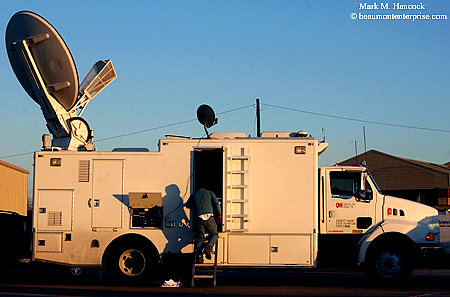
Ray Schultz of Dallas prepares a CNN satellite truck near sundown at Time Warner cable company in Nederland on Wednesday, December 13, 2006. A CNN story about racism in Vidor was interrupted on Tuesday at local Time Warner stations.
A CNN satellite truck is prepared for a live interview of Vidor's mayor by CNN's Paula Zahn at Time Warner cable company in Nederland. Vidor was previously known as a "sunset town." In the Old South, a sunset town was one where minorities were not welcome and often harassed or worse after sunset.
CNN reporter Keith Oppenheim talks with Paula Zahn via satellite at Time Warner cable company in Nederland. Oppenheim filed the original story about racism and Vidor. The Vidor-related segment of the CNN story about racism was interrupted on Tuesday at local Time Warner stations. Time Warner claims it was a technical glitch caused by a technician's human error.
Vidor Mayor Joe Hopkins (left) talks with CNN's Paula Zahn via satellite at Time Warner cable company.

Vidor Mayor Joe Hopkins talks with CNN's Paula Zahn via satellite at Time Warner cable company in Nederland. After initially accepting to host a CNN town hall meeting about racism in Vidor, he canceled the agreement and cited "security" as the reason.
I waited to post this story because it kept getting more interesting. I was scheduled to cover the CNN town hall meeting in Beaumont on Tuesday, but I ended up at a basketball game while Jennifer covered the meeting (I'm still not quite sure how this happened).
I've already said racism is a problem in Southeast Texas. CNN decided to give it some national attention. This caused some grumblings. However, when the Vidor segment of the Paula Zahn Now special on racism was about to air, homes in Vidor and Beaumont only saw dead air on CNN. (See the video)
It also took what could have been an embarrassing moment for Vidor and propelled it into a national incident. After speaking with Vidor's mayor, Paula Zahn's production wanted to host a town hall meeting about racism in Vidor.
First, the mayor said OK. Then, he changed his mind and canceled the meeting citing "security" as the reason.
Beaumont Mayor Guy Goodson helped move the meeting to Beaumont to examine this important issue.
Before the meeting, Zahn went to Vidor to interview Mayor Joe Hopkins. There was no security problem in Vidor while she visited. She then came to Beaumont and conducted the town hall meeting with all the panelists without a security incident.
Please read "When We Lost The CNN Signal" on Fayrouz's blog to understand this strange story.
Please also read "CNN racism forum raises issues for some" by Dee Dixon as well as the related links.
Saturday, December 09, 2006
Avoid anything Nygard
I was going to post some fluffy images from fashion designer Peter Nygard's visit to Beaumont during his nationwide tour of Dillard's stores. Then, I found this CRAZY rights-grabbing cattle call from "senior fashion photographer" John Bartelings (via Model Mayhem). Read it for yourself if you want to see what's absolutely unacceptable.
They wanted student photographers to follow the designer around and pop flashes to add some razzle dazzle for the TV and video shooters. The whole tour is a staged event; why wouldn't they stage this as well?
Here's the crux of it:
This doesn't apply to the media. It's actually for the media (TV). If media folks in other cities could avoid covering the event and feeding this horrible abuse of photo students (and future fashion copy-cats), please do so.
Enough for now,
They wanted student photographers to follow the designer around and pop flashes to add some razzle dazzle for the TV and video shooters. The whole tour is a staged event; why wouldn't they stage this as well?
Here's the crux of it:
"(HOWEVER: NO PUBLICATION RIGHTS-SEE WAIVER FORM) they will provide their own equipment and own film/Memory Cards - NOTE: CF cards will - after download - be returned to the photographer they will follow instructions from our Staff Photographers & Nygård Officers ... they will provide their presence FREE of charge they have to sign the attached Waiver Form and return it when picking up the Media Pass..."I'm surprised the student shooters didn't need to provide caviar and goblets of blood samples.
This doesn't apply to the media. It's actually for the media (TV). If media folks in other cities could avoid covering the event and feeding this horrible abuse of photo students (and future fashion copy-cats), please do so.
Enough for now,
Thursday, July 13, 2006
Stupid like a Fox
Y'all know how I react to attempts to control freedom of the press. Now, the Fox network (owned by News Corp) has decided to challenge AP and specifically press PJs. The Washington Post reports:
Personally, I haven't ever seriously watched Fox television. This latest ploy is simply one more reason to avoid anything related to Fox.
Now, if AP really wants to make a point, it should see how many Television Critics Association members it can talk into abstaining from the tour (since they are print and online journalists). Another nice move would be to refuse to report on anything Fox - except the slander suits of course.
For working press PJs who want to show their solidarity with AP, all that's required is three little words in the Special Instructions section of the next image you transmit: "News Corp OUT."
Enough for now,
UPDATE: According to Photo District News, AP and Fox TV Reach Photo Coverage Agreement.
The Associated Press is protesting plans by Fox to bar photographers from its news conferences at the Television Critics Association press tour and says it will not cover the events unless the network changes the policy.Bravo AP. Thanks to Justin for pointing out this conflict.
Read more...
Personally, I haven't ever seriously watched Fox television. This latest ploy is simply one more reason to avoid anything related to Fox.
Now, if AP really wants to make a point, it should see how many Television Critics Association members it can talk into abstaining from the tour (since they are print and online journalists). Another nice move would be to refuse to report on anything Fox - except the slander suits of course.
For working press PJs who want to show their solidarity with AP, all that's required is three little words in the Special Instructions section of the next image you transmit: "News Corp OUT."
Enough for now,
UPDATE: According to Photo District News, AP and Fox TV Reach Photo Coverage Agreement.
Subscribe to:
Posts (Atom)


