Showing posts with label Fort Worth. Show all posts
Showing posts with label Fort Worth. Show all posts
Tuesday, July 07, 2020
Double Closing Day
video, photos and listing by Mark M. Hancock / © DFWmark.com
Double Closing Day! I couldn't be happier for my Clients!
We got multiple offers over asking price and sold their home in Fort Worth. They did everything perfectly. Now they have a beautiful new-build home in Aubrey.
Although this journey is complete, I’ve Still Got Your Six!
Mark M. Hancock
REALTOR, GRI, MRP, Certified New Home Sales
DFWmark.com


Sunday, July 01, 2012
Fort Worth Museum of Science and History

Photos © Mark M. Hancock / DFWmark.com
Artifacts are displayed in the permanent DinoLabs, Cattle Raisers Museum exhibits as well as the special Native American history display at the Fort Worth Museum of Science and History in Fort Worth on Saturday, Aug. 7, 2010.
YouTube version of this slideshow with music composed in GarageBand by Mark M. Hancock. Please set your viewer quality to 1080p.
Sunday, March 18, 2012
Downtown Fort Worth

Photos © Mark M. Hancock / DFWmark.com
One of the two 48-foot tall angels on the Grand Facade of the Bass Performance Hall appears to blow its horn in Fort Worth on Saturday, July 7, 2010.
See a larger version of this slideshow.
Fayrouz Hancock visits some sites in downtown Fort Worth on Saturday, July 7, 2010.
Thursday, November 17, 2011
NCAA Regional Baseball Championship
 photos © Mark M. Hancock and The Dallas Morning News
Oral Roberts' senior Joey Winiecki (11) dodges the glove of Dallas Baptist's junior Joel Hutter (12) after stealing second base during the NCAA regional baseball championship game in Lupton Stadium at Texas Christian University in Fort Worth on June 5, 2011.
See a larger version of this slideshow.
Oral Roberts battles Dallas Baptist during the NCAA regional baseball championship game in Lupton Stadium at Texas Christian University in Fort Worth.
Named in this slideshow are: Bob Keller, Will Lane, Duncan McAlpine, Chris Elder, Nick Baligod, Tyler Robbins, Jared Schlehuber, Mark Guest, Bennett Pickar, Kenny Hatcher, Cam Schiller, Brandon King, Joey Winiecki, Dan Heefner, Michael Smith and Joel Hutter.
photos © Mark M. Hancock and The Dallas Morning News
Oral Roberts' senior Joey Winiecki (11) dodges the glove of Dallas Baptist's junior Joel Hutter (12) after stealing second base during the NCAA regional baseball championship game in Lupton Stadium at Texas Christian University in Fort Worth on June 5, 2011.
See a larger version of this slideshow.
Oral Roberts battles Dallas Baptist during the NCAA regional baseball championship game in Lupton Stadium at Texas Christian University in Fort Worth.
Named in this slideshow are: Bob Keller, Will Lane, Duncan McAlpine, Chris Elder, Nick Baligod, Tyler Robbins, Jared Schlehuber, Mark Guest, Bennett Pickar, Kenny Hatcher, Cam Schiller, Brandon King, Joey Winiecki, Dan Heefner, Michael Smith and Joel Hutter.
Monday, October 13, 2008
Dr. Dog howls

photos © Mark M. Hancock and The Dallas Morning News
Bassist Toby Leaman of Dr. Dog perform at Lola's Saloon in Fort Worth on Friday, Sept. 12, 2008.

Dr. Dog of Philadelphia performs at Lola's Saloon in Fort Worth.

Scott McMicken of Dr. Dog performs in Fort Worth.

Bassist Toby Leaman (left) and drummer Juston Stens (right) of Dr. Dog perform at Lola's Saloon in Fort Worth.
Please read, "Philly band Dr. Dog plays a tangy show at Lola's in Forth Worth" by Mike Daniel / The Dallas Morning News
Saturday, September 27, 2008
Legal resident citizenship workshop

photos © Mark M. Hancock and Al Dia
Legal residents begin paperwork during a citizenship workshop at the Northside Community Center in Fort Worth on Saturday, Aug. 23, 2008.

Angel Hernandez of Haltom City (left) signs in at Laticia Lopez Morales' station during a citizenship workshop.

Legal residents work with volunteers during a citizenship workshop at the Northside Community Center.

Legal residents work with volunteers during a citizenship workshop. Guests attended classes and got personal assistance to complete applications and help them prepare for naturalization.

Juanita (left to right) and Urbano Rodriguez of Fort Worth answer questions during a citizenship workshop.

Douglas Inteviano, executive director of Proyecto Inmigrante, (left) and volunteer Erika Martinez (right) work with legal residents during a citizenship workshop.

Volunteer Adriana Cadena (left) works with Guadalupe Flores of Dallas (right) during a citizenship workshop.

Raul Jarillo (left) helps Leonardo Torres (of Fort Worth with a computer program during a citizenship workshop at the Northside Community Center.

David Cecenas of Fort Worth (left) completes the process with immigration attorney Alice Margaret Gruber (right) during a citizenship workshop at the Northside Community Center.

Maria Herrera, co-founder of Casa de Imigrante, (left to right) brings coffee to volunteers Francisca Dominguez and Alberto Juarez during a citizenship workshop at the Northside Community Center in Fort Worth. Guests attended classes and got personal assistance to complete applications and help them prepare for naturalization.
Please read, "Asisten con proceso de solicitud de ciudadanía" by Thalia I. Longoria
(translated)
Monday, August 04, 2008
Cowtown Drag Boat Nationals

The engine of Doug Verstuyft's top fuel hydro boat undergoes repairs in the pits before the Cowtown Drag Boat Nationals at Marine Creek Lake in Fort Worth on Sunday, Aug. 3, 2008.
photos © Mark M. Hancock / ZUMA

Wayne Hopf works on the the engine of Doug Verstuyft's San Antonio-based top fuel hydro boat in the pits before the Cowtown Drag Boat Nationals. The event was a point event for the Southern Drag Boat Association's High Point Series Championship and drew competitors from across the United States and Canada.

Ricky Sanchez of Caldwell, Texas works on his modified eliminator boat in the pits before the Cowtown Drag Boat Nationals.

The sign on a boat notes the sports' difference during the competition in Fort Worth.

Todd Byler with Lone Star Tow Boats checks the lanes before the Cowtown Drag Boat Nationals on Marine Creek Lake in Fort Worth.

Jerrett Silvey of New Braunfels, Texas leaps his top fuel hydro from the rope during the Cowtown Drag Boat Nationals. The straight, quarter-mile runs can be completed in about five seconds by the fastest top fuel hydroplane boats.

Daryl Ehrlich of Midland, Texas (No. 318, left) jumps to start a top fuel hydro race. The fastest boats deploy parachutes designed to scoop water at the end of the run.

Randy Benson (No. 411) powers his pro modified boat to an easy win during the Cowtown Drag Boat Nationals.

A disappointed Doug Verstuyft of San Antonio (center) get towed back to the ramp after his engine caught fire during the Cowtown Drag Boat Nationals.

Steve Westerfield of Lake Forest, Calif. (No. 440, left) and Marcus Kinsey of Marble Falls, Texas (No. 079, right) race blown alcohol boats at Marine Creek Lake.

Ronnie Hodge of San Antonio goes airborne in his modified eliminator boat during a Cowtown Drag Boat Nationals race in Fort Worth.

Vic Fugate of Fort Worth (No. 314, right) takes the lead in his top eliminator boat in Fort Worth.

Garrett Everett of San Angelo, Texas (No. 000, bottom) races against Kevin Crane of Lubbock (No. 065, top) during a stock eliminator run.

Kevin Conklin (No. 828, left) of Midland, Texas races against Ronnie Hays of Oklahoma City (No. 7771, right) in the top eliminator class.

Gary Payne of Lorena, Texas (No. 372, left) races against Brett Cheadle of Tomball, Texas (No. 006, right) in a modified eliminator run during the Cowtown Drag Boat Nationals at Marine Creek Lake in Fort Worth.
Saturday, March 05, 2005
Tornado season is coming

Mark M. Hancock / © The Dallas Morning News
Eliza Cook looks through her home at 6159 Ramey Ave. in East Fort Worth where a tornado tore through her neighborhood on Tuesday, April 16, 2002. She said she was praying on the bed when the tornado touched down across the street and destroyed the neighbors home (seen through the window). The tornado shattered every window in Cook's home as well as pulling off much of her roof. Cook has lived in the home since 1957. Her family said she had no insurance to cover the damage.
The flowers are blooming, fresh leaves are budding after a long winter nap, ladybugs have returned to brighten our day. In most of the country, this is called spring. In Texas and the Midwest, it's called tornado season.
As I've said before, tornados are challenging. Typically, PJs are the first responders (because we were sent into the tornado itself). As a result, we must have some answers and offer help to the traumatized.
Although it's important to get the shots and make deadline, please ask people if they have insurance to cover the damage. If they don't, they need help from your readers. Newspaper readers have big hearts and will help their neighbors. Tell them how to help and they will.
After big natural disasters, large organizations call for donations and handle distribution. After smaller disasters, it's up to the community to establish bank account for donations for the affected. Let the neighborhood know they need to create such an account and give them the telephone number to the newsroom to get the information published.
Carry plenty of Federal Disaster Relief forms (PDF file) for anyone who looks lost. It's not much, but it gives them some hope in the face of instantaneous, overwhelming tragedy. Although some journalists might object to my sense of mission, PJs are at the scene to show what happened and to mobilize the readers into action. PJs are there to visually document the situation, then our readers understand the need for their help.
I'll add one shooting tip though. Find the highest bridge or other overlook of the scene. The natural tendency is to go into the middle of the situation. Tornadoes flatten everything. There's not much to shoot on the trail of a tornado because everything is gone. By shooting from a nearby bridge or other high position (helicopters are best), viewers can comprehend the path and damage of the tornado better from the unaffected homes nearby. The overall image normally runs 1A while images such as above run secondary.
Enough for now,
Monday, February 28, 2005
Sometimes it's too fast
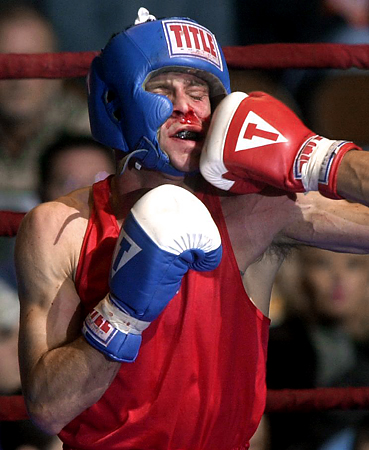
Featherweight open boxer Raul Barrientes (left) takes a shot from Jose Hernandez (red glove right) during the Fort Worth Golden Gloves boxing tournament at the Will Rogers Memorial Center complex on February 23, 2002. Hernandez won the fight.
Mark M. Hancock / © The Dallas Morning News
This is an example of a rare occurrence of my strobes/shutter set too fast. This frame is shot somewhere around f/8 at 1/500 or 1/640. The resulting image looks like the red glove is placed delicately in the frame.
If we look closely, his head is beginning to spin around inside his safety headgear. Had I shot at 1/250 or maybe a little slower to let some available light blur the frame, it would've been more obvious how hard he was hit.
Consequently, sometimes it's important to keep the speed slower than possible. Hockey, boxing and karate look the most strange if there is no touch of motion to give the feel of speed and power. Basketball and volleyball hold up the best at super-high speeds.
Enough for now,
Monday, November 22, 2004
Ivan Moravec performs

© Mark M. Hancock and The Dallas Morning News
Pianist Ivan Moravec performs at the Bass Performance Hall in Fort Worth on Monday, November 22, 2004.
Piano concerts are a challenge. Typically, the performer concentrates on his/her hands on the ivories. If it's in a darkened hall, this means the pianist's face is normally in shadow. Add to this the need to blimp the camera, there's no way to get the keys in the same frame as the performer’s eyes, they typically wear black on a dark background with a black piano... The problems mount.
The high point of an entire concert (from a PJ's point of view) is when the pianist suddenly looks up and possibly raises one hand high enough to see. It's the visual equivalent of a blocked punt.
Enough for now,
Saturday, November 20, 2004
Turkey Leg Classic
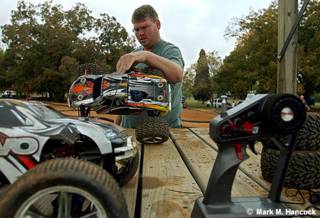
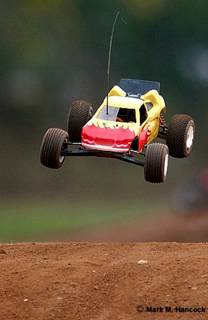
I'm posting these as a group because they don't make sense as stand-alone images. The Turkey Leg Classic is an annual remote-controlled auto race. The gasoline-powered autos have an average cost of about $1,200 and are capable of speeds faster than 50 miles per hour. On scale, these vehicles move faster than any race cars. It makes for an interesting shoot.
Photos © Mark M. Hancock and The Dallas Morning News
(Above) Mike Hyams of Tulsa, Okla. prepares his remote-controlled truck at Johnny Cool Guy Raceway in Fort Worth on Saturday, November 20, 2004.
(Right) A remote-controlled auto flies over a hill during The Turkey Leg Classic.
(Below) Clifton Adams of Forney, Texas operates his remote-controlled auto.
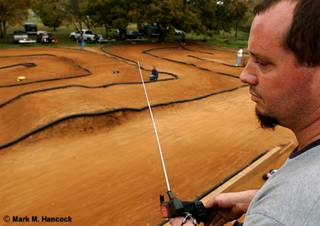
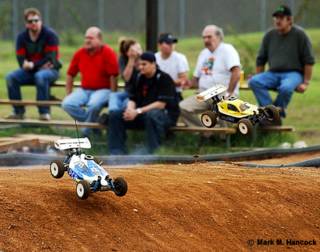
Fans of remote-controlled racing watch as cars fly over a hill.

Photos © Mark M. Hancock and The Dallas Morning News
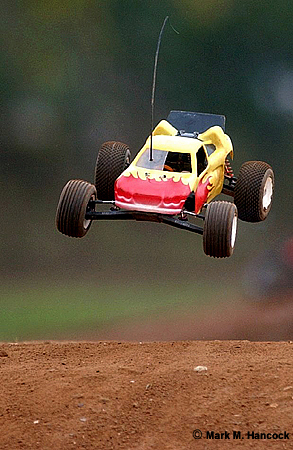
(Above) Mike Hyams of Tulsa, Okla. prepares his remote-controlled truck at Johnny Cool Guy Raceway in Fort Worth on Saturday, November 20, 2004.
(Right) A remote-controlled auto flies over a hill during The Turkey Leg Classic.
(Below) Clifton Adams of Forney, Texas operates his remote-controlled auto.

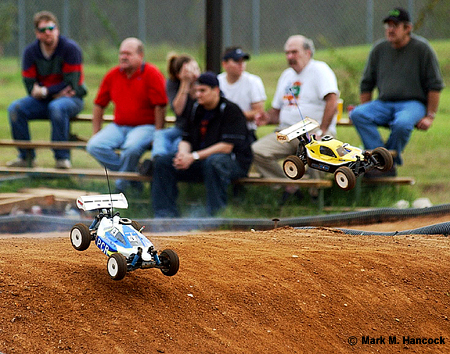
Fans of remote-controlled racing watch as cars fly over a hill.
Tuesday, October 26, 2004
How to shoot fast-track auto races - Part II

Mark M. Hancock / © The Dallas Morning News
David Starr (No. 75, left) holds off Jack Sprague (No. 16, right) during the NASCAR Craftsman Truck Silverado 350K race at the Texas Motor Speedway in Fort Worth on Saturday, October 16, 2004.
In Part I of this post, we went over the logistics of access and pre-race preparation issues. Today we’ll discuss getting the shots. PJs expect to shoot a lot of frames at every assignment. Auto racing requires an even higher take to get solid, publishable images.
Unlike many other sports, the sequence is unpredictable. PJs may get the best shots immediately after the start and not get safe shots until halfway through the race.
Before the race
If PJs have commitments for time and print space (designated open holes), work the area around the speedway. Some racers, fans and sponsors camp on the outskirts of the speedway area or in the infield. There are hundreds of potential features and photo stories available in the camping areas.
If a team of PJs are covering the event, consider juxtaposing team owners at near-by luxury hotels with camping fans. What are the differences and similarities?
Work the parking lot for tailgate party images. These tend to be colorful and flamboyant. Try to work the speedway into the background to give the images a sense of place.
Immediately surrounding the speedway’s front gates is something similar to a race carnival. Sponsors and vendors transform semi-trailers into everything from take-away restaurants to interactive, state-of-the-art race simulators. These displays are extremely colorful and get the fans fired-up for the main event as well as creating brand loyalty. Within a few hours of the final race’s finish, they are packed up and gone. There are several visual possibilities here as well – particularly if coordinated with the Business section reporters.
PJs with pit access work the teams and crews for “down time” images. The motor crews work hard, but they also play hard and enjoy extreme sports. Look for drivers doing something unrelated to racing (cuddling children, skateboarding, playing with toys, etc...).
The pole
The “scoreboard” in an auto race is the infield pole. The pole has typical lighted numbers like other scoreboards, but it is read from top to bottom. The top number is the lap number. The name of most races includes the total number of laps. However, check to get the correct number of laps (as opposed to miles or kilometers) before the race begins. Knowing the lap number is critical as the finish of the race approaches.
Next, vehicle numbers are displayed in order from 1st to 20th down the pole. At the bottom of the pole are the lap times of the two lead vehicles.
PJs can watch the pole for changes as well as estimating if the second vehicle is about to make a move on the lead vehicle (because the lap time might be slightly higher).
Get the safe shots
Again, the safe shots aren’t sequential. Safe shots are determined by the number of starting racers in any particular race. Visual opportunity, stress (of missing “the” shot) and danger increases as the number of racers increase. Meanwhile, the number of safe shots decreases because of the previous statement. I’ll describe the absolute safest route, but scale back as the field size increases.
There is no anticipating who’ll wreck or win from the start to the finish. The absolute safe shots begin before the race. Get shots of each car (preferably with its driver) before the race begins. This lets PJs know the paint colors and patterns of each car for IDs later. At a high 45-degree angle, PJs can capture the front, top and side markings of each vehicle. It’s enough to confirm the difference between each car. The cars are displayed before each race and this allows PJs to run down the line to document each car (as well as its pole position).
Introductions
Before each race, drivers are introduced and make a quick statement to the fans. Avoid "talking head at microphone" shots and work the line of drivers waiting for introductions. This gives PJs a chance to get quick mug shots or features of the racers interacting while they aren’t wearing helmets.
Watch the flags
Above the start/finish line is a flag stand. The person in this stand determines the status of the race by waiving different colored flags. It’s safe to get an image of this person waiving each color flag. We don’t know what controversies are brewing in the pits or owners’ boxes, but the flags will often be able to represent a problem.
Flag meanings:
Green flag = start (both initial start and restart)
Yellow flag = caution (wreck or debris on track)
Red flag = full stop (wreck on track / emergency situation)
White flag = one lap left
Checkered flag = finish line
Furled flag = final lap before an action (often a furled green flag before a restart)
Caution flags
After a wreck, the vehicles bunch together and move relatively slowly behind the pace car while the wreck is cleared. This is a chance to get tight shots of one to three cars per frame. If something horrible happens to one of the remaining cars, the PJ can use these images to represent the story (because the wreck was on the opposite side of the track behind a wall or some time later in a different city).
Recovered vehicles
Vehicle recovery isn’t like on the highways. The wrecker attaches a hook to the top of the disabled vehicle, lifts and off it goes to the infield. It happens within a few minutes. Because there might be some additional story about why the vehicle wrecked or had a mechanical problem, take one or two loose shots of the recovery vehicle with the car attached.
Winner’s celebration
After the finish of each NASCAR race, the winner burns some donuts near the finish line. Both the roof and infield shooters should expect and document this.
Next, there will be a standard trophy/check presentation with obligatory champagne, juice, soda or milk splashing. This is typically handled by the infield PJs because there’s not enough time for roof shooters to get the finish and make it to the infield before this is a done deal.
These images add a genuinely happy human face to a story about machines. Frequently, these images get better play than actual race images. So, although they're listed as "safe shots," they’re also required.
Luckily for PJs, the racers have seen/participated in enough of these celebrations to know how to make a good show for PJs. They play the scene like most experienced rock stars and give PJs different visual and layout options. Think of it as an elaborate touchdown dance.
What’s important?
Since the difference between vehicles is slight, the winner of a race is all about the driver and pit stops.
Drivers
Drivers are judged by their aggression to the front. The most successful drivers take calculated risks and expect less-aggressive drivers to back away. It’s a millimeter game of chicken. If neither backs down, a wreck can happen and neither wins.
A driver’s aggression is visually represented by passing. A good driver takes the prime course through a track and tries to pass on the straitaways. An aggressive driver tries to pass in the turns as well (either high or low on the track). The most aggressive drivers will try to force a three-car pass (normally low on the track) and hope the other two realize the danger and back down.
Believe it or not, this may be the most exciting event of the whole race, so the PJ better get it. When all three drivers are superior, the PJ may get two or three turns to follow this battle. If any one of the three has a temporary lapse of reason, everyone goes into a wall, and the PJ is already on it.

Mark M. Hancock / © The Dallas Morning News
Crew members work on Dennis Setzer's truck during the NASCAR Craftsman Truck Silverado 350K race at the Texas Motor Speedway in Fort Worth on Saturday, October 16, 2004.
Pit stops
The machines are basically traveling from Dallas to Little Rock (New York to Virginia / Italy to Poland) in about an hour and a half. This requires lots of fuel, new tires and other repairs. Since each fraction of a second is important, all fueling, tire changes and repairs must be done simultaneously in a matter of seconds. This is done by a highly-coordinated pit team.
The team members are well-paid professionals in a potentially deadly area. A fraction of a second is also the difference between a fire and/or a broken leg in the pit. Shoot the activities of these technicians because it’s equally important to getting the win.

Mark M. Hancock / © The Dallas Morning News
Alex Barron's mangled Indy car skids across the infield during the IRL Chevy 500 race at the Texas Motor Speedway in Fort Worth on Sunday, October 17, 2004.
Look for wrecks
As with everything else, I don’t wish a wreck on anyone. I hope all the racers finish. However, most of the time, they won’t. Machines break. Editors and readers expect to see wrecks if they happen. PJs are expected to get these (preferably mid-air with a clean background).
Wrecks can happen anywhere on the track at any time. However, there are some predictable situations to watch. An additional problem is speed. If a car even wiggles, hit the auto-winder because the car will disintegrate faster than the brain can tell the finger to shoot.
Major wrecks occur when vehicles are close together. The likelihood of a wreck is increased in the turns. Each track has one or two turns which are wreck magnets. When all are combined, it’s obvious where to watch.
Bunched vehicles
If a vehicle loses a tire, it will spin and wreck. If it’s surrounded by other cars at the time, they all share the joy. Consequently, major wrecks are most likely at the beginning of the race or at restarts after a yellow-flag caution.
For PJs, it’s like jumping on a bus going 60 mph. The cars move slowly for several laps during the yellow, the green is waived, the cars accelerate and another wreck happens. If PJs aren’t ready, it’s over.
To be ready for an initial wreck, follow the largest groups of vehicles during the majority of the race. This is the most likely place for problems. The leader is the least likely to wreck because s/he normally has more time to react (unless passing the tail at the time). The group directly behind the leader is the most aggressive, so it’s the best place to look.
Similarly, when one vehicle tries to pass another vehicle, they may get very close together and occasionally bump. Get the bump, but if the bump is too hard and either vehicle loses traction, both may go for a tumble.
Turns
Although fast-tracks are banked, vehicles are most likely to lose traction in the turns. If the track gets wet, expect dangerous turns.
Trick turns
No matter how well a track is engineered, each turn or curve has its own character. Typically one turn creates more problems for drivers than others. Knowing which turn is most likely to cause problems is good for PJs.
Research the track’s history and/or ask other PJs or fans which turns create the most problems. Find a position to cover this particular turn and watch it particularly when more than one vehicle tries to take it at the same time.

Mark M. Hancock / © The Dallas Morning News
Chad Blount (No. 2, left) spins out and pushes Denny Hamlin (No. 03, right) into the wall during the NASCAR Craftsman Truck Silverado 350K race at the Texas Motor Speedway in Fort Worth on Saturday, October 16, 2004.
Secondary wrecks
Although PJs may miss the primary wreck, get on it quick because a wreck normally causes secondary wrecks. A damaged car slows down and/or may veer in any direction. Meanwhile, other cars are speeding into the wreck area. This causes additional braking and swerving. Secondary wreck can be caused by both the reaction to the initial wreck or from the original wreck skidding and entering the track again at a different location.
Try something creative
For most of the race, nothing visually significant happens. For PJs running two camera rigs, this allows time for some experimentation. Try some slower exposure pans with the vehicles to blur colorful backgrounds or foregrounds. It’s also interesting to juxtapose still items (people in lawn chairs on motor homes) against the blurring cars on the track.
Some other novel ideas can be silhouettes, nighttime flash synchs, layering speeding vehicles inside interesting foreground elements, reflections, negative space experiments or any number of other gadgets in the PJ toolbox.

Mark M. Hancock / © The Dallas Morning News
Helio Castroneves of Sao Paulo, Brazil takes the checkered flag to win the IRL Chevy 500 race at the Texas Motor Speedway in Fort Worth on Sunday, October 17, 2004.
Get the finish
I can’t overstate the importance of this singular frame (at these speeds, there’s only one frame). The whole day’s shoot (as well as time trials) leads to this one frame. Better have it or quickly catch the next plane to “anywhere.”
Plan for the finish
There are no visual surprises with the finish of a fast-track race. A vehicle (maybe two) crosses a specific line on the track at a specific speed after a specific number of laps. The PJ must be in place, have fresh batteries and disks/film and know what and how to shoot before the white flag lap.
Before the race, find the best position for a clear shot at the finish line. This isn’t normally the best place to shoot the race, so look at it from several angles. PJs want an unobstructed view and a clean background with a clear view of the finish line and, preferably, the checkered flag.
If PJs cover time trials or more than one race, they should practice timing the finish for each type of vehicle. Since every camera has a different shutter lag time, it’s best to know exactly when to shoot to align the vehicles with the finish line. A few test frames on dit cameras is strongly advised.
When the race has 20 laps left, change batteries. When only five laps remain, get in position and change to new disks and/or film. This should eliminate the sinking feeling some experience when the camera won’t fire at the exact moment it MUST. It also makes editing easier on deadline.
Execute the finish
As the race draws to a close, the PJ is in the right place with fresh batteries and disks/film. The PJ also knows the shutter lag time and has a visual shooting mark to compensate for the microsecond delay.
However, this still doesn’t guaranty a decent image. To get a good shot, we go back to the photography basics: exposure, timing and focus. We have already have timing figured out.
Next, during the last lap or two, use one or more alternate means to verify correct exposure. Because the track may be black or near white with a broad white painted line, PJs may need to manually control the exposure for the finish. Additionally, the winning car might be white or black and again give a wrong meter reading. Set the correct exposure for the light falling on the finish line.
The last of the three elements is focus. Autofocus doesn’t mean it can focus on a speeding auto at the right time. Switch to manual focus and prefocus on the finish line with enough depth-of-field to handle the difference between the ground and the top of the driver’s head or vehicle.
Lastly, get it. Look at the pole to spot the correct leader. As the leader comes into view, pan the camera with the car until it hits the shutter lag marker and shoot and wind through a few frames (there could still be a wreck after the finish). Notice how the first shot is actually the only shot expected.
If a PJ expects to get the finish with frames per second, the finish will be missed. The vehicle will speed over the finish line at around 3/8000ths of a second. Even at 6 FPS, this gives a PJ 7,994 chances to fail. I’d rather take the 1-in-3 chance.
By panning on the leader, the PJ ensures the vehicle is the sharpest object in the frame. Otherwise, the car still blurs.
If PJs don’t want to risk as much on 3/8000ths of a second, they can increase their odds by dropping down EV toward a slower shutter speed. This creates more area blur -- not particularly bad if one’s trying to show speed -- and is more forgiving of timing (249 chances of failure at 1/250th vs. 1,999 at 1/2000th).
Enough for now,
Tuesday, October 19, 2004
Green Day two

Mark M. Hancock / © The Dallas Morning News
Billie Joe Armstrong (left) and drummer Tre Cool (right) of Green Day perform during a concert at the Fort Worth Convention Center in Fort Worth on Tuesday, October 19, 2004.
Green Day spotlight

Billie Joe Armstrong of Green Day performs in the spotlight during a concert at the Fort Worth Convention Center in Fort Worth on Tuesday, October 19, 2004.
Mark M. Hancock / © The Dallas Morning News
How to shoot fast-track auto races - Part I

Mark M. Hancock / © The Dallas Morning News
Vitor Meira (No. 17, left), Tony Kanaan (No. 11, center) and Helio Castroneves (No. 3, right) battle for the lead during the IRL Chevy 500 race at the Texas Motor Speedway in Fort Worth on Sunday, October 17, 2004. Castroneves won the race. Kanaan had sewn up the series win before the race began. He is the only racer to complete every lap of every race of the entire season of any major motor sport series.
I shot my first major auto racing events this weekend. I had a steep learning curve (Ouch!). Consequently, most of the issues in this post are from the "I wish I had..." category.
I thought horse racing was difficult and stressful. The horses move fast and only cross the finish line once. At least with the cars, I figured I'd have several attempts at them – you know - since they go round and round. Silly rabbit. No horse runs this fast. BTW, cars only cross the finish line once as well -- at 212 mph.
After the first day’s Silverado 350K (NASCAR trucks), I realized how hard it is to shoot races. So, I went back to the office and studied each and every photo in our archive and tried to figure out what the other PJs did and what makes good shots. I did much better on the second day with the Indy cars during the IRL Chevy 500K (they’re even faster).
Since this is an expanding sport (it’s already big, but it’ll get even bigger), I’ll share what I’ve learned from a weekend’s worth of panic, frustration and mistakes.
Get proper credentials
Luckily the desk handles most of the pre-race credentials legwork. Additionally the paper is a major sponsor, so we get some preferential treatment. For those who want to run the gauntlet solo, start early to get everything in proper order well before race day.
Even if PJs work for mid-sized newspapers, they may want to talk with their editors about acceptable double-dipping with a regional magazine to bump up their credential bid request.
Most speedways will probably require written requests for credentials. Go to the nearest track’s Web site and find credential information or the media relations coordinator for inquiries.
Like most other big events, the number of credentialed PJs will be limited. It’s not only an access issue, it’s a safety issue as well (at least two PJs were gruesomely killed while covering races in recent years). Additionally, people who’ve invested huge money into speedways and racing teams want the widest possible publication for their efforts. They need to draw fans and additional resources to keep the biz going.
Even with all the previous requests and authorizations, the PJ is required to present a photo ID and personally receive the access badge and parking permit as well as sign a waiver of liability. Get it as early as possible to avoid lines and chaos.
If the PJ has highly-limited access (roof, pit), make sure to get the additional credentials or stickers. If additional safety vests are required, pay the deposit early and get it before the last-minute rush.
Practice wherever possible
I’d strongly suggest shooting time trials (and anything else) to get a grip on handling the long lenses, speed and course design. Obviously the time trials are the best option. Try several locations and angles. Find the best locations to cover the most corners (where accidents are most likely to happen).
Practice panning skills to get proper rhythm for good images. Track vehicles through turns to access how much depth-of-field will be required (during a pan from start to finish without blind [mirror up] focusing).
Although I’m accustomed to big lenses, this kicked it up a notch for me. I maxed-out everything the second day (600mm with a 2X converter on a dit – effectively a 1,800mm lens).
If logistics don’t allow PJs to go for time trials, at least practice on a nearby highway. Make this practice as hard as possible on yourself. It’ll be worse on the track, so get good before the pressure hits.
Find the fastest road nearby. Set up a tripod and the longest lens available. Work to get sharp images of smallest cars on the road (preferably in a fast curve). Next, try to frame up only the drivers’ faces. I already hear the squeaks out there. The point is to be prepared for a relatively small object traveling at aircraft speeds (about 1/3 the speed of sound).
To do this, the PJ must get long glass, then double it, then move it as close as (safely) possible to the moving objects. Each level of expertise requires a smaller target to keep within the viewfinder frame.
Bring the right equipment
The standard PJ gear is needed for racing. Obviously, long lenses and a tripod are preferred. However, the PJ will need to bring some extra items as well.
Hearing protection
High quality earplugs or gun range/industrial hearing muffs will do. Try to get protection for at least 21 decibels of sound. In either case, protect your hearing.
If opting for earplugs, choose the right size. Try to find U.S. Army issue earplugs, which come in different sizes. These can also be easily cleaned with soap and water. Use foam rubber earplugs only as a last option since they aren’t as effective nor as sanitary after the first use.
The muffs allow PJs to listen to a radio play-by-play of the race by also wearing earbuds inside the muffs. When choosing muffs, research before buying. These aren’t horribly expensive (compared to photographic equipment), but it's important for them to work well without creating additional distractions for the PJ.
Choose muffs with well-padded ear covers and headband. Additionally, make sure it's solidly constructed rather than snap-together plastic. The headband should be made of flexible metal.
For PJs planning to pursue this sport, high-quality ear covers with built-in speakers can wire directly to Bearcat-style radio scanners. The allow PJs to hear drivers talk with their pit crews during the race.
Food and water
Eat well before getting into position. PJs will need energy to make it trough each race. Additionally, take extra bottles of water in belt holsters. Most races are held in during the afternoon with no overhead shade. It gets hot, and PJs need enough water to make it through the race without needing to run to the restroom.
Radio with earbuds
Most tracks have radio agreements for race days. Find out the proper frequency and preset tuner buttons. Get a small armband radio or a small one that can clip to a camera bag or tuck securely into a shirt pocket.
Attach earbuds (miniature earphones which insert into the ear) to the radio, and cover them with protective ear muffs.
The radio will be about 10 seconds behind actual action, so it isn't much use to let the PJ know what's happening on the track. However, between peak action moments, the announcers will talk about side issues of importance. Make sure to address visually as many side issues as possible (track conditions, records, milestones, etc.).
Security rope
Security ropes are critical for anyone shooting from the roof. Securely tie each lens onto each tripod or monopod. Then use a separate rope to tie the support to posts atop the building. No PJ wants to even consider what would happen if a gust of wind tossed a 600mm on a tripod off the roof and onto the spectators below.
Even if the camera is securely attached to the PJ with a camera strap, I’d still suggest a secondary rope attaching it to the PJ’s waistbag or photovest.
Additional precautions such as taping lenses onto cameras with gaffer's tape might be a good idea. If it could be a problem, it’s best to fix is first.
It isn’t as large a problem for the infield, but the vacuum of cars passing can easily pick up light items and create major problems. Make sure coolers, chairs and such are secure and won’t blow away under any circumstances.
Other safety gear
This is a sport where I don’t think anyone could be too safe. If the PJ has access and funds for fireproof suits or a helmet (for infield shooters), go ahead and get it. Everyone else is wearing helmets and fireproof suits, so you won’t be the only nerd in the infield.
As a side note, photographers aren’t allowed to wear shorts at major race tracks. They will be told to put on long pants or leave because exposed skin can lead to fire-burned skin and nobody wants it.
Camping equipment
Some PJs bring collapsible lawn chairs, small ice chests and other creature comforts. Make sure they are out of major pathways and all items are tied down.
Get there early
I got to the Texas Motor Speedway hours before start times. Judging from the traffic snarl near the speedway, I can only imagine how miserable it must be for a big NASCAR event. Probably it’s best to camp overnight for the big events.
From what I understand, more than 100,000 people attend the Texas NASCAR races. About 94,000 attended yesterday’s Chevy 500, the IndyCar series finale and championship. This is almost 15,000 more than attended the 2004 Texas/OU shootout football game (79,587).
Learn the game
Start with NASCAR 101 and the Indy Car overview. Knowledge about the driver/team stats and personalities as well as the track itself is vital to shooting the right cars in the right places at right time.
Without being a "gearhead," the visual concepts are simple. Key elements of the game are speed, passes, wrecks, pit stops, and the finish. These determine who wins the race. Every major race has the same elements plus a victory celebration.
Get the start sheets
Get a list of participants and pole positions (where they start). The sheets should be available in the media center. If PJs did as suggested above, they already know who the racers, owners and sponsors (cumulatively the players) are. They’ll also know which (if any) of the players are local or about to break some significant record or milestone.
Otherwise, scan the information sheets for any clues. If nobody appears to be local, ask around. Local players are needed for future stories. Get help from the media relations professionals (they are walking encyclopedias of information). Likewise, the team members and even fans can point PJs toward interesting sidebar stories.
At least find the closest racer to the PJ's readership. This is most important in IRL (Indy Racing League) because the teams tend to be international.
Then PJs are ready to get in place and get the job done.
Enough for now,
Please see Part II.
Saturday, October 09, 2004
Mavs new faces
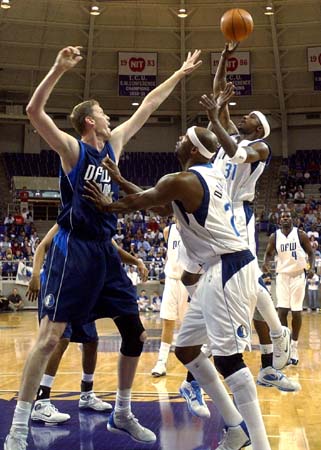
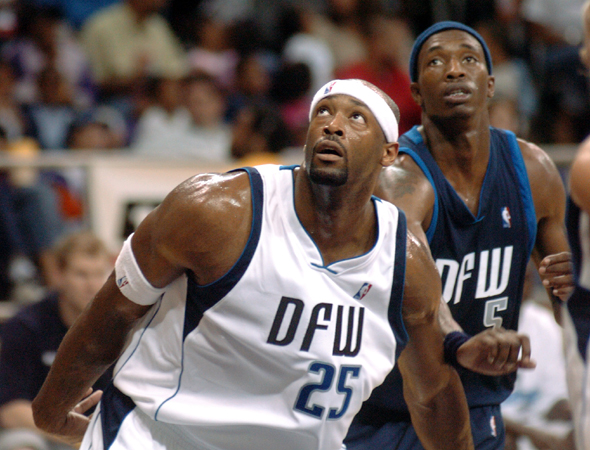
Jason Terry (No. 31, top right) tries to shoot past Shawn Bradley (No. 44, left) as Erick Dampier (No. 25, lower right) works to block during the annual Dallas Mavericks Blue-White basketball scrimmage at TCU in Fort Worth on Saturday, October 9, 2004.
Mark M. Hancock / © The Dallas Morning News
Dampier blocks
Mark M. Hancock / © The Dallas Morning News
Erick Dampier (No. 25, left) blocks Josh Howard (No. 5, right) after a free throw attempt during the annual Dallas Mavericks Blue-White basketball scrimmage at TCU in Fort Worth on Saturday, October 9, 2004.
Wednesday, July 28, 2004
Add text to images

Dancer Lori Barber (right) and musician Greg Fiellin (left) pair up for "Harlem Nocturne" during a performance of "Swing" at Bass Hall in Fort Worth on Tuesday, June 10, 2003.
Mark M. Hancock / © The Dallas Morning News
When I was preparing my entries for the Katies, so were some other staffers. The instructions were a little vague, so we decided to include paper proofs of our images and cutlines with the CDs.
I'll explain the process for anyone else who wants to know. It's important to remember the cutline becomes part of the image (a jpg, tiff, eps, etc.). It isn't a text block as Quark XPress or the other layout programs would create.
A big advantage to embedding text as part of the image is increased copyright protection. If a copyright symbol (©), name and date are part of an image, someone else can't claim ignorance in a courtroom. The infringer would have deliberately misused the image and can be slammed for heavy damages.
Here's how to do it:
- Open the image in Adobe Photoshop
.
- Prepare the image as needed.
- The image should be in the correct orientation (horizontals are, verts are).
- Using the drop-down menus, go to Image, then Canvas Size. A dialog box appears.
- Increase the Height by 4 to 6 inches. This adds to both the top and bottom of the image.
- Using the Crop tool, remove any undesired section (top or bottom) by excluding it from the crop area (crop includes the image and the main text area). Crop.
- Select the Text tool from the tool box (it's the big "T"). Mouse the tool over the text area and click. On older versions, a dialog box appears. On newer versions, the text can be typed directly into the area.
- Set text font, size and color.
- Type desired text. Use Return to break lines because it's not text, it's raster characters, which look like text. Close the dialog box, or choose the Lasso tool and make a circle to set the text.
- Crop off the remainder of the unused cutline area.
If you need a print, Size the image (Image, drop down to Image Size) to fit the paper size. If the image is horizontal and you want to see it as a landscape print, rotate the entire image and size to fit the paper.
Print.
Enough for now,
Subscribe to:
Posts (Atom)


